
Allied Telesis AT-MMC2000/SP-960 PERP 10/100/1000T to SFP
Networks > Network Adaptors > Miscellaneous
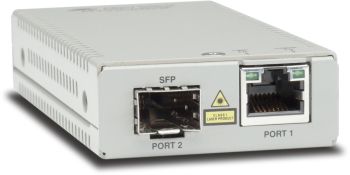
Allied Telesis AT-MMC2000/SP-960 PERP 10/100/1000T to SFP
| Lieske Part No. | 1542568 |
|---|---|
| Mfg Part No | AT-MMC2000/SP-960 |
| EAN-Code | 0767035218632 |
| Manufacturer | Allied Telesis |
| Here only | 125,00 EUR
148,75 EUR incl. VAT
|
Further information for Allied Telesis AT-MMC2000/SP-960 PERP 10/100/1000T to SFP
| Certificates | |
| Certification | CE, UL60950-1, EN60950-1, FCC Class A, EN55022 Class A, CISPR 22 Class A, C-TICK, VCCI |
| Features | |
| Product colour | Silver |
| Internal | |
| Logistics data | |
| Harmonized System (HS) code | 85176990 |
| Network | |
| Maximum data transfer rate | 1000 Mbit/s |
| Converter input interface | 10Base-T, 100Base-T, 1000Base-T |
| Converter output interface | 1000Base-SX |
| Networking standards | IEEE 802.1Q |
| Ethernet interface type | Gigabit Ethernet |
| Ethernet LAN data rates | 10,100,1000 Mbit/s |
| Fiber ethernet cabling technology | 1000BASE‑SX |
| Jumbo frames support | |
| VLAN support | |
| Operational conditions | |
| Operating temperature (T-T) | 0 - 50 °C |
| Storage temperature (T-T) | -30 - 70 °C |
| Operating relative humidity (H-H) | 5 - 95% |
| Storage relative humidity (H-H) | 5 - 95% |
| Operating altitude | 0 - 3048 m |
| Packaging content | |
| User guide | |
| Manual | |
| Quick installation guide | |
| Performance | |
| Maximum transfer distance | 500 m |
| Wavelength | 850 nm |
| Fiber mode structure | Multi-mode |
| Ports & interfaces | |
| Connectivity technology | Wired |
| Ethernet LAN (RJ-45) ports | 1 |
| Fiber optic connector | SFP |
| Power | |
| Input voltage | 12 V |
| Input current | 0.14 A |
| Weight & dimensions | |
| Width | 54.9 mm |
| Depth | 101.6 mm |
| Height | 21.8 mm |
| Weight | 170 g |
Applications
The media converter is suitable for use in professional networks, particularly in environments where extending the transmission distance beyond copper cables is necessary. The maximum transmission distance is 500 meters, making it suitable for applications in medium to large buildings or between buildings within a campus. It is frequently used in IT infrastructure to connect existing RJ-45 connections with fiber optic cables without requiring additional network devices such as switches or routers. The use of multi-mode fiber with a wavelength of 850 nm ensures efficient data transmission over the specified distance.
Features and Equipment in Detail
The device features an RJ-45 port for the input connection in the Ethernet standard 10/100/1000Base-T. The output side is equipped with an SFP slot designed for connecting an optical transceiver in the 1000Base-SX format. Support for Jumbo Frames enables the transmission of larger data packets, which can improve network efficiency in certain application scenarios. VLAN support according to IEEE 802.1Q allows network segmentation into logical subnetworks, optimizing network management and security. The maximum data transfer rate is 1000 Mbit/s, complying with the Gigabit Ethernet standard.
Technology Explained Simply
The media converter operates as a passive network component that does not perform additional network logic such as routing or switching, but exclusively handles signal conversion between copper and fiber optic cables. The input side receives electrical signals via an Ethernet cable (RJ-45), converts them into optical signals, and transmits them over the fiber optic cable. On the receiving side, the conversion back to electrical signals takes place. The use of multi-mode fiber with an 850 nm wavelength is optimized for short to medium distances and offers a good balance between cost and performance. Power supply is via a 12 V DC voltage with a current consumption of 0.14 A.
Compatibility and Accessories
The converter is compatible with standard Ethernet connections in the 10/100/1000Base-T format and with SFP transceivers in the 1000Base-SX standard. The use of SFP modules allows flexible adaptation to different fiber optic cable types and lengths, achieving a maximum range of 500 meters with multi-mode fibers. The devices are designed for use in networks supporting the IEEE 802.1Q standard for VLANs. The connection is made via wired technologies, with the optical side implemented through the SFP slot.
Mounting and Installation
The device is not built-in but is designed as a standalone module. It has a compact form factor with dimensions of 54.9 mm (width) × 101.6 mm (depth) × 21.8 mm (height) and weighs 170 g. Installation involves connecting an Ethernet cable to the RJ-45 interface and inserting an SFP transceiver into the optical slot. The operating temperature range is 0 to 50 °C, and the storage temperature range is -30 to 70 °C. Relative humidity during operation is 5 to 95 %, without condensation. The maximum operating altitude is 3048 meters. The delivery includes a user manual, operating instructions, and a quick installation guide.
Advantages in Operation
Using the media converter enables a cost-efficient extension of existing networks via fiber optic cables without requiring additional network devices. Support for Gigabit Ethernet and Jumbo Frames ensures high data rates and efficient transmission. VLAN support provides additional options for network organization. The compact design and simple installation make the device a practical solution for network extensions. Certifications including CE, UL60950-1, EN60950-1, FCC Class A, EN55022 Class A, CISPR 22 Class A, C-TICK, and VCCI guarantee compliance with relevant safety and emission standards.

This is an offer of:
79279 Vörstetten
https://industry-electronics.com
Tel. 07666/88499-0
Fax. 07666/88499-111
Diesen Artikel finden Sie unter:
industry-electronics.com/artikel/1542568

Lieske Elektronik e.K.
Reutener Str. 1079279 Vörstetten
https://industry-electronics.com
Tel. 07666/88499-0
Fax. 07666/88499-111
Diesen Artikel finden Sie unter:
industry-electronics.com/artikel/1542568