
Allied Telesis AT-MC101XL-60 Media Converter 100TX-100FX
Networks > Media-Converters
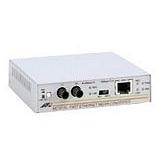
Allied Telesis AT-MC101XL-60 Media Converter 100TX-100FX
| Lieske Part No. | 455970 |
|---|---|
| Mfg Part No | AT-MC101XL-60 |
| EAN-Code | 0767035191737 |
| Manufacturer | Allied Telesis |
| Here only | 180,44 EUR
214,72 EUR incl. VAT
|
Further information for Allied Telesis AT-MC101XL-60 Media Converter 100TX-100FX
| Certificates | |
| Safety | UL-Cul, CSA/CSA, NRTL, TUV, CE |
| Features | |
| Compliance industry standards | IEEE 802.3u, IEEE 802.1Q |
| Logistics data | |
| Harmonized System (HS) code | 85176990 |
| Network | |
| Maximum data transfer rate | 100 Mbit/s |
| Cabling technology | 100Base-TX UTP, 100Base-FX F |
| Operational conditions | |
| Operating temperature (T-T) | 0 - 40 °C |
| Storage temperature (T-T) | -20 - 80 °C |
| Operating relative humidity (H-H) | 5 - 95% |
| Operating altitude | 0 - 3048 m |
| Other features | |
| Dimensions (WxDxH) | 104.6 x 95.25 x 25.4 mm |
| Interface | Fast Ethernet |
| Electromagnetic emissions | FCC Class A |
| I/O ports | 1x RJ-45 (MDI/MDI-X) 1x ST 100Base-FX |
| Power requirements | 100-240 VAC, 50-60Hz |
| Full duplex | |
| Performance | |
| Maximum transfer distance | 2000 m |
| Power | |
| Power consumption (typical) | 6 W |
| Weight & dimensions | |
| Weight | 294 g |
Applications
The media converter is suitable for applications requiring a connection between copper and fiber optic infrastructures, for example, extending LAN networks over longer distances. It can be used to integrate new devices into existing networks without requiring a complete cable replacement. The maximum transmission distance is 2000 meters, making it suitable for applications in medium to large building complexes or between buildings. The use of fiber optic cables enables higher interference resistance and lower signal attenuation over long distances.
Functions and Equipment in Detail
The converter features two ports: one RJ-45 port (MDI/MDI-X) for connection to UTP cables and one ST connector for 100Base-FX fiber optic cables. The MDI/MDI-X function allows direct connection to other devices without additional crossover cables. The full-duplex function enables simultaneous data transmission in both directions, increasing network efficiency. Power supply is via 100–240 VAC, 50–60 Hz, ensuring worldwide usability. Power consumption in standard operation is 6 W.
Technology Explained Simply
The converter operates according to the standards IEEE 802.3u (Fast Ethernet) and IEEE 802.1Q (VLAN support). The conversion takes place at the physical layer (Layer 1), where the signal is transferred from one medium to another without modifying the data packets. The fiber optic cable connection via ST connector is designed for multimode fibers, enabling use in local networks. The maximum range of 2000 meters is achieved under ideal conditions, with actual range depending on fiber quality, light source, and connection technology.
Compatibility and Accessories
The converter is compatible with standard 100Base-TX and 100Base-FX devices. The use of multimode fiber optic cables with ST connectors is required.
Mounting and Installation
The converter is compact with dimensions 104.6 x 95.25 x 25.4 mm and a weight of 294 g. It can be mounted in standard 19-inch racks or operated free-standing. Installation is done by connecting to a UTP cable (RJ-45) and a fiber optic cable (ST connector). Operating temperature ranges from 0 to 40 °C, and storage temperature from -20 to 80 °C. Relative humidity during operation is 5–95 %, and operation is possible up to an altitude of 3048 m.
Advantages in Operation
Using the converter enables flexible network design, combining the advantages of copper and fiber optic cables. Fiber optic cables offer greater range and interference resistance, while copper cables are more cost-effective and suitable for short distances. The conversion is transparent to the network application, so no changes to network configuration are required. Certifications UL-Cul, CSA/CSA, NRTL, TUV, CE and compliance with FCC Class A requirements for electromagnetic emissions ensure a safe and interference-free operating environment.

This is an offer of:
79279 Vörstetten
https://industry-electronics.com
Tel. 07666/88499-0
Fax. 07666/88499-111
Diesen Artikel finden Sie unter:
industry-electronics.com/artikel/455970

Lieske Elektronik e.K.
Reutener Str. 1079279 Vörstetten
https://industry-electronics.com
Tel. 07666/88499-0
Fax. 07666/88499-111
Diesen Artikel finden Sie unter:
industry-electronics.com/artikel/455970