
Allied Telesis AT-DMC100/LC-50 media converter 100TX to 100FX LC connector
Networks > Media-Converters
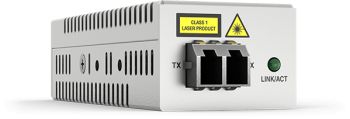
Allied Telesis AT-DMC100/LC-50 media converter 100TX to 100FX LC connector
| Lieske Part No. | 1107979 |
|---|---|
| Mfg Part No | AT-DMC100/LC-50 |
| EAN-Code | 0767035209920 |
| Manufacturer | Allied Telesis |
| Here only | 177,99 EUR
211,81 EUR incl. VAT
|
Further information for Allied Telesis AT-DMC100/LC-50 media converter 100TX to 100FX LC connector
| Certificates | |
| Compliance certificates | RoHS |
| Features | |
| Product colour | Grey |
| Internal | |
| LED indicators | |
| DIN rail mounting | |
| Logistics data | |
| Harmonized System (HS) code | 85176990 |
| Network | |
| Maximum data transfer rate | 100 Mbit/s |
| Converter input interface | 100Base-TX |
| Converter output interface | 100Base-FX |
| Networking standards | IEEE 802.1Q |
| Fiber ethernet cabling technology | 100BASE-FX |
| Data transfer rate | 100 Mbit/s |
| Duplex system | Full, Half |
| Auto MDI/MDI-X | |
| Auto-negotiation | |
| Link Loss Carry Forward (LLCF) supported | |
| Link Loss Return (LLR) supported | |
| Operational conditions | |
| Operating temperature (T-T) | 0 - 40 °C |
| Storage temperature (T-T) | -15 - 65 °C |
| Operating relative humidity (H-H) | 5 - 95% |
| Storage relative humidity (H-H) | 5 - 95% |
| Operating altitude | 0 - 3048 m |
| Performance | |
| Maximum transfer distance | 2000 m |
| Wavelength | 1310 nm |
| Fiber mode structure | Multi-mode |
| Fiber cable diameters supported (core/cladding) | 50/125,62.5/125 µm |
| Tx power (min) | -22.5 dBmW |
| Tx power (max) | -14 dBmW |
| Rx power (min) | -32 dBmW |
| Rx power (max) | -14 dBmW |
| Ports & interfaces | |
| Connectivity technology | Wired |
| Ethernet LAN (RJ-45) ports | 1 |
| Fiber ports quantity | 1 |
| Fiber optic connector | LC |
| Weight & dimensions | |
| Width | 31.8 mm |
| Depth | 91.4 mm |
| Height | 21.6 mm |
Applications
This media converter is particularly suitable for applications requiring a stable and reliable network connection over long distances. With a maximum transmission distance of 2000 meters over multi-mode fiber optic cable (core/cladding: 50/125 µm or 62.5/125 µm), it is ideal for building connections, industrial facilities, or campus networks. The use of LC connectors enables a compact and secure optical connection. The operating temperature range of 0 to 40 °C and storage temperature range of -15 to 65 °C make the device suitable for indoor environments, with a maximum operating altitude of 3048 meters.
Functions and Features in Detail
The converter supports Auto-Negotiation, allowing it to automatically negotiate the optimal transmission rate and duplex mode (full- or half-duplex) with the connected device. The Auto MDI/MDI-X function enables direct connection to PCs, hubs, or switches without requiring additional cable reconfiguration. The LED indicators display operational status, including system status, fiber and RJ45 connection, and activity. The integrated Link Loss Carry Forward (LLCF) and Link Loss Return (LLR) functions ensure that network communication over the fiber link continues uninterrupted until the connection is restored.
Technology Explained Simply
The converter operates at a wavelength of 1310 nm and is designed for multi-mode fiber optic cable. The optical output power (Tx) ranges from -22.5 dBmW (min) to -14 dBmW (max), while the receive power (Rx) varies between -32 dBmW (max) and -14 dBmW (min). These values ensure stable signal transmission over the specified distance. The IEEE 802.1Q support enables transparent forwarding of VLAN packets, allowing the converter to be used in modern networks with Virtual LANs without dropping data packets.
Compatibility and Accessories
The converter is designed for use with 100Base-TX copper cables (RJ45) and 100Base-FX fiber optic cables. The LC connector is integrated as standard. Power supply is provided via a USB cable, which can be connected directly to a laptop or PC. Alternatively, an optional AC/DC adapter can be used. Mounting is done via DIN rails, enabling flexible installation in enclosures.
Installation and Mounting
Installation is simple and requires no special tools. The converter is mounted on the DIN rail and connected to the network device (e.g., switch) using a UTP cable. The fiber side is connected to the fiber cable using an LC connector. The integrated Link Test function allows verification of the fiber connection integrity without requiring specialized optical measuring equipment. Power supply via USB accelerates installation and reduces the number of required cables.
Operational Advantages
The converter features a compact design (31.8 mm width, 91.4 mm depth, 21.6 mm height) and low power consumption. USB power supply reduces installation costs and the number of required connections. Support for Smart MissingLink (SML) and Smart Link Restoration enables fast fault detection and automatic re-establishment of the connection after disruptions, enhancing network reliability. RoHS compliance ensures environmental compatibility of the device. The device is gray in color, allowing seamless integration into standardized enclosures.

This is an offer of:
79279 Vörstetten
https://industry-electronics.com
Tel. 07666/88499-0
Fax. 07666/88499-111
Diesen Artikel finden Sie unter:
industry-electronics.com/artikel/1107979

Lieske Elektronik e.K.
Reutener Str. 1079279 Vörstetten
https://industry-electronics.com
Tel. 07666/88499-0
Fax. 07666/88499-111
Diesen Artikel finden Sie unter:
industry-electronics.com/artikel/1107979