
ABB Automation BC6-30-01-P-1.4-81 contactor 24 V DC
Industrial Material > Industrial relays and contactors > Contactors
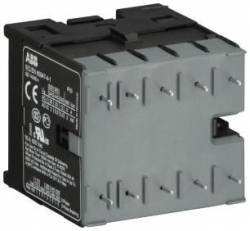
ABB Automation BC6-30-01-P-1.4-81 contactor 24 V DC
| Lieske Part No. | 474196 |
|---|---|
| Mfg Part No | GJL1213009R8011 |
| EAN-Code | 4013614053429 |
| Manufacturer | ABB |
| Here only | 62,03 EUR
73,82 EUR incl. VAT
|
Further information for ABB Automation BC6-30-01-P-1.4-81 contactor 24 V DC
| General | |
| Rated control supply voltage Us at DC | 24 |
| Voltage type for actuating | DC |
| Rated operation current Ie at AC-1, 400 V | 12 |
| Rated operation current Ie at AC-3, 400 V | 9 |
| Rated operation power at AC-3, 400 V | 4 |
| Rated operation power NEMA | 1.4914 |
| Number of auxiliary contacts as normally open contact | 0 |
| Number of auxiliary contacts as normally closed contact | 1 |
| Type of electrical connection of main circuit | PCB connection |
| Number of normally closed contacts as main contact | 0 |
| Number of main contacts as normally open contact | 3 |
| Depth | 47.7 |
| Height | 45.2 |
| Operating voltage at AC 50 Hz | 690 |
| Operating voltage at AC 60 Hz | 690 |
| Width | 47.5 |
| Modular version | |
Applications
This contactor is designed for use in electrical installations where switching of motors or other loads is required. It is frequently used in automation technology, manufacturing industry, or machine construction applications where a reliable and compact switching solution is needed. The series is rated for loads up to 5.5 kW at AC-3 (400 V), making it suitable for a wide range of drive systems. Control is via DC voltage, which is common in many control systems.
Functions and equipment in detail
The contactor features three normally closed main contacts intended for the main current circuit. Additionally, it includes one normally open auxiliary contact, which can be used for control or signalling purposes. The main current circuit is connected via printed circuit board terminals, enabling flexible mounting. The operating voltage is 690 V at 50 Hz and 690 V at 60 Hz, allowing use in standardised industrial installations. The rated operating currents are 12 A for AC-1 (400 V) and 9 A for AC-3 (400 V), with a rated power of 4 kW at AC-3 (400 V).
Technology explained simply
The contactor operates using an electromagnetic coil that, when supplied with control voltage (24 V DC), pulls in the armature and thereby closes the main contacts. The main contacts consist of three normally closed contacts that switch the current circuit for the load (e.g. an electric motor). The integrated auxiliary contact (normally open) can be used for additional control functions, for example to transmit signals to a control system. The printed circuit board terminal connection allows direct mounting on a circuit board, minimising space requirements. The rated power of 1.4 W according to the NEMA standard refers to the electrical power consumed by the coil to operate the contactor.
Compatibility and accessories
Various accessories are available for this contactor to extend its functionality. These include varistor surge suppressors such as RV-BC6/250 (for 110–250 V AC/DC) and RV-BC6/60 (for 24–60 V AC/DC), which suppress voltage spikes during switching off. Thermal overload relays such as models T16-0.55, T16-1.3, T16-10, or T16-16 can be connected for motor protection. Electronic overload relays such as E16DU-18.9 or E16DU-1.0 offer additional protection functions with adjustable trip classes. A protective cap (LT6-B) is also available to protect the contactor from mechanical influences. The accessories can be mounted laterally or frontally, enabling flexible integration into existing installations.
Mounting and installation
The contactor is not designed for panel mounting, but for individual mounting. Installation is via printed circuit board terminals, allowing it to be soldered directly onto a board or connected using plug connectors. Dimensions are 47.5 mm (width), 45.2 mm (height), and 47.7 mm (depth), making it a compact component. Mounting does not require special tools, but secure connections must be ensured to guarantee reliable operation.
Advantages in operation
The contactor offers high reliability in compact dimensions, making it particularly suitable for installations with limited space. The use of printed circuit board terminals enables quick and secure installation. The integrated auxiliary contact function (normally open) expands control possibilities without requiring additional components. Compatibility with various accessories such as surge suppressors and overload relays allows flexible adaptation to different requirements. The operating voltage of 690 V at 50 and 60 Hz makes it suitable for use in international industrial installations. Control via 24 V DC is standard in many control systems, simplifying integration.

This is an offer of:
79279 Vörstetten
https://industry-electronics.com
Tel. 07666/88499-0
Fax. 07666/88499-111
Diesen Artikel finden Sie unter:
industry-electronics.com/artikel/474196

Lieske Elektronik e.K.
Reutener Str. 1079279 Vörstetten
https://industry-electronics.com
Tel. 07666/88499-0
Fax. 07666/88499-111
Diesen Artikel finden Sie unter:
industry-electronics.com/artikel/474196