
ABB Automation 2CMA100164R1000 three-phase meter RS485
Measurement > Counter / coin, hour meter
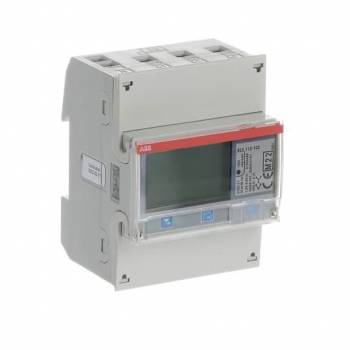
ABB Automation 2CMA100164R1000 three-phase meter RS485
| Lieske Part No. | 737131 |
|---|---|
| Mfg Part No | 2CMA100164R1000 |
| EAN-Code | 7392696001649 |
| Manufacturer | ABB |
| Here only | 300,20 EUR
357,24 EUR incl. VAT
|
Further information for ABB Automation 2CMA100164R1000 three-phase meter RS485
| General | |
| Maximum current | 65 A |
| Display type | seven-segment display |
| Number of display digits | 7 |
| Measured quantity | active energy, powers, currents, voltages (L-L, L-N), frequency |
| Energy class | 1 |
| Communication interface | RS485 (Modbus RTU), Infrared |
| Calibration | MID |
| Approval | IEC |
| Built-in width | 4 DIN modules |
| Display per phase and total | |
| Pulse output | |
Applications
The meter is suitable for use in industrial, commercial and municipal installations where precise energy measurement is required. It is typically installed in distribution enclosures or switchgear, where it is directly connected to the power supply. The mounting width of 4 DIN modules allows for compact installation in standard switchboards. Certification according to IEC and calibration according to MID ensure the legal validity of the measured values, qualifying it for applications in the public or regulated energy sector.
Functions and equipment in detail
The meter features an integrated RS485 interface, enabling data exchange via the Modbus RTU protocol. This allows connection to monitoring or building management systems. Additionally, an infrared interface is available, which can be used to connect to a KNX module. These interfaces expand integration options into existing automation systems. An impulse output is also integrated, which can be used for external counting or monitoring devices.
Technology explained simply
Measurement is performed electronically, with active energy recorded according to Class 1. This means the measurement accuracy meets the requirements of the MID directive, which applies to the calibration of energy meters in the EU. The display with up to 7 digits provides sufficient space for large numerical values, as occur in long-term measurements. The integrated RS485 and infrared interfaces enable flexible communication, with RS485 suitable for serial data transmission over longer distances and infrared used for short, point-to-point queries.
Compatibility and accessories
To extend functionality, additional devices such as the energy analyser QA/S3.64.1 (article number 2CDG110227R0011) or QA/S3.16.1 (article number 2CDG110226R0011) as well as the Control Unit SCU100 (article number 2CCG000242R0001) can be used. These components enable detailed energy analysis and integration into higher-level control systems. The mentioned accessories are designed for use with the B23 112-100 and extend the meter's application possibilities.
Mounting and installation
The meter is mounted in standard switchboards, with the mounting width of 4 DIN modules to be taken into account. Installation is done via direct connection, ensuring the maximum permissible current of 65 A is not exceeded. Electrical connections are made via the designated terminal clamps. The communication interfaces RS485 and infrared are already integrated and do not require additional modules for basic functionality.
Advantages in operation
The combination of high measurement accuracy (Class 1), integrated communication interfaces and the ability to connect to KNX systems provides a flexible and reliable solution for energy measurement. Calibration according to MID and IEC certification ensure the legal validity of the measured values. The seven-segment display allows for quick visual inspection of values on site, while digital interfaces enable remote monitoring and data logging. The impulse output allows use in systems requiring external counting or signal inputs.

This is an offer of:
79279 Vörstetten
https://industry-electronics.com
Tel. 07666/88499-0
Fax. 07666/88499-111
Diesen Artikel finden Sie unter:
industry-electronics.com/artikel/737131

Lieske Elektronik e.K.
Reutener Str. 1079279 Vörstetten
https://industry-electronics.com
Tel. 07666/88499-0
Fax. 07666/88499-111
Diesen Artikel finden Sie unter:
industry-electronics.com/artikel/737131