
ABB Automation 2CDL210011R1057 PS1/57NA phase bar
Installation > Distributor Cabinets > Meter Cabinets
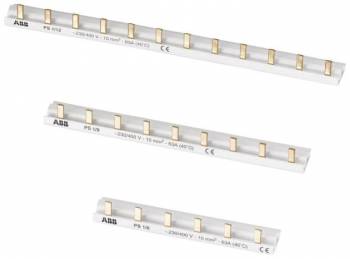
ABB Automation 2CDL210011R1057 PS1/57NA phase bar
| Lieske Part No. | 202103 |
|---|---|
| Mfg Part No | 2CDL210011R1057 |
| EAN-Code | 4016779579728 |
| Manufacturer | ABB |
| Here only | 28,01 EUR
33,33 EUR incl. VAT
|
Further information for ABB Automation 2CDL210011R1057 PS1/57NA phase bar
| General | |
| Number of phases | 1 |
| Number of poles | 57 |
| Suitable for number of devices | 57 |
| Pitch dimensions | 44698 |
| Cross section | 10 |
| Length | 996 |
| Rated permanent current Iu | 63 |
| Type of electric connection | Pin |
| Max. rated operation voltage Ue | 690 |
| Rated short-time withstand current lcw | 25 |
| Colour | Other |
| Width in number of modular spacings | 57 |
| Insulated | |
| Suitable for devices with N-busbar | |
| Suitable for devices with auxiliary switch | |
Applications
The phase bar PS1/57NA is designed for use in electrical distribution systems, particularly in meter enclosures, where a high number of modules and secure power distribution are required. It is suitable for devices requiring a neutral conductor, making it appropriate for use in single-phase and multi-phase systems with a neutral conductor. The bar is not intended for devices with auxiliary switches, as these require special mounting incompatible with the standard construction of the PS1/57NA.
Functions and Equipment in Detail
The bar features a connection cross-section of 10 mm², enabling a current rating up to 63 A (rated continuous current Iu). This value is critical for sizing the electrical installation, as it indicates the maximum current the bar can carry continuously without causing thermal overload. The maximum rated operating voltage is 690 V, making the bar suitable for applications in industrial and commercial environments. The rated short-time withstand current (Icw) is 25 kA, indicating the bar’s ability to withstand short-term current surges during short-circuit events without structural damage.
Technology Explained Simply
The phase bar is supplied as a standard phase bar, meaning it is delivered in the fixed length of 996 mm and is not cuttable. The module unit is 44698, relevant for mounting in standardized enclosures. The bar is designed for single-phase systems, with the pole count of 57 indicating the number of mountable modules. The insulation of the bar protects against unintended contact and reduces the risk of short circuits. The pin terminals enable a secure and mechanically stable connection to the devices.
Compatibility and Accessories
The PS1/57NA is compatible with devices requiring a neutral conductor and is suitable for use in single-phase systems. As suitable accessories, the connection terminal SZ-ESK3 (manufacturer's number 2CDL200003R5001) is offered, designed for cross-sections from 6 to 50 mm². This terminal can be used for secure connection of the phase bar to external conductors. Combination with other devices such as circuit breakers or residual current protective devices is possible, provided the devices do not feature auxiliary switches.
Mounting and Installation
Mounting is carried out in a meter enclosure or distributor, where the bar is inserted into the designated mounting openings. Positioning depends on the number of modules to be connected. The pin terminals are connected to the corresponding devices, with the insulation of the bar ensuring electrical safety. The bar is not cuttable, so length must be considered during selection.
Advantages in Operation
The PS1/57NA provides reliable power distribution across 57 modules, enabling efficient installation of multiple devices in one enclosure. The insulation and high short-time withstand current increase operational safety. The use of standard phase bars simplifies planning and installation, as dimensions and connection types are standardized. Compatibility with devices requiring a neutral conductor expands the range of applications in various use cases.

This is an offer of:
79279 Vörstetten
https://industry-electronics.com
Tel. 07666/88499-0
Fax. 07666/88499-111
Diesen Artikel finden Sie unter:
industry-electronics.com/artikel/202103

Lieske Elektronik e.K.
Reutener Str. 1079279 Vörstetten
https://industry-electronics.com
Tel. 07666/88499-0
Fax. 07666/88499-111
Diesen Artikel finden Sie unter:
industry-electronics.com/artikel/202103