
ABB Automation 2CDG110024R0011 safety module SCM/S1.1
Installation > Home Automation > EIB material
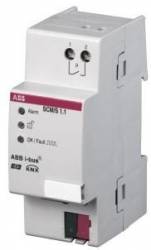
ABB Automation 2CDG110024R0011 safety module SCM/S1.1
| Lieske Part No. | 311437 |
|---|---|
| Mfg Part No | 2CDG110024R0011 |
| EAN-Code | 4016779583916 |
| Manufacturer | ABB |
| Here only | 349,60 EUR
416,02 EUR incl. VAT
|
Further information for ABB Automation 2CDG110024R0011 safety module SCM/S1.1
| General | |
| Mounting method | DRA (DIN-rail adapter) |
| Width in number of modular spacings | 2 |
| Bus system KNX | |
| Bus connection included | |
| Logic object | |
Applications
The module is specifically designed for integration into KNX-based security systems. It enables central monitoring and control of security components in residential and commercial buildings. Its applications range from simple alarm systems to complex, multi-level security concepts where various sensors, doors, windows, and control stations are interconnected. Integration is achieved via standardized communication objects that ensure data transmission between devices.
Functions and Equipment in Detail
The SCM/S1.1 can monitor up to 64 alarm groups, where each group may consist of multiple sensors or security components. Arming, operation, and display of security states are also managed via communication objects, enabling flexible and centralized control. An integrated freely controllable relay output allows connection to an external signaling device, such as a siren or light signal, to visually or acoustically indicate alarms. The functions are designed to seamlessly integrate into existing KNX infrastructures.
Technology Explained Simply
The module operates within the KNX-bus system, an open standard for building automation that enables communication between different devices. The bus coupling ensures the module can be directly connected to the KNX network. As a logical building block, it processes inputs from various sources, performs logic operations, and sends corresponding commands to other devices. Communication occurs via communication objects, which represent standardized data points for transmitting states such as armed", "disarmed", or "alarm. The buffered KNX power supply is required to maintain security functions even during a power failure, as the module does not have an internal battery or buffering capability.
The REG mounting type means the module is installed into a standard installation rail commonly used in electrical installations. The width of two division units corresponds to the standard format for many KNX modules, allowing compact placement in distribution boxes or enclosures.
Compatibility and Accessories
The module is designed for use in the KNX network and is compatible with all devices supporting the KNX standard. It can be combined with various security terminals, sensors, and control stations to create a comprehensive security system. Control is achieved via communication objects configured in KNX software.
Installation and Mounting
Installation is performed on a standard installation rail (REG mounting type). The module is inserted into the rail and mechanically secured. Electrical connection is made via the KNX bus lines, which are connected to the bus coupling. Configuration of logic functions, alarm groups, and communication objects is done using KNX programming software connected to the network via a PC or laptop with an appropriate interface (e.g., USB interface). Settings depend on the specific application and desired security logic.
Operational Advantages
The module enables centralized, flexible, and scalable control of security functions within a KNX network. The use of communication objects ensures standardized and error-free communication between devices. The ability to monitor up to 64 alarm groups offers high scalability. The relay output allows control of external signaling devices, providing flexible alarm notification. Integration into existing KNX systems requires no additional hardware, reducing system complexity. The requirement for a buffered power supply ensures security functions continue to operate during power outages, which is critical for demanding applications.
Note: Internal battery or power buffering is not included in the delivery scope.

This is an offer of:
79279 Vörstetten
https://industry-electronics.com
Tel. 07666/88499-0
Fax. 07666/88499-111
Diesen Artikel finden Sie unter:
industry-electronics.com/artikel/311437

Lieske Elektronik e.K.
Reutener Str. 1079279 Vörstetten
https://industry-electronics.com
Tel. 07666/88499-0
Fax. 07666/88499-111
Diesen Artikel finden Sie unter:
industry-electronics.com/artikel/311437