
ABB Automation SCU100 control unit with web server
Installation > Home Automation > POWER EIB
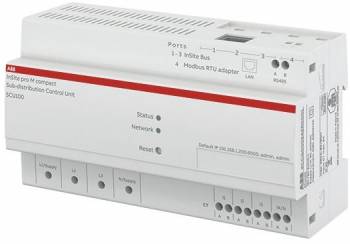
ABB Automation SCU100 control unit with web server
| Lieske Part No. | 1920215 |
|---|---|
| Mfg Part No | 2CCG000242R0001 |
| EAN-Code | 7612271508104 |
| Manufacturer | ABB |
| Here only | 1.030,86 EUR
1.226,72 EUR incl. VAT
|
Further information for ABB Automation SCU100 control unit with web server
| General | |
| Type of accessory | Communication and measuring function |
Applications
The SCU100 is designed for the acquisition of AC and DC currents on the outgoing side. It can monitor up to 96 sensors simultaneously, with data collected from up to 3 x 32 sensors. The measured values include energy, active power and reactive power, taking into account the input side of the power measurement. This enables precise analysis of energy consumption and efficiency of individual consumers or entire circuits. Integration into energy management systems is therefore directly possible without additional hardware.
Functions and Equipment in Detail
A central component of the SCU100 is the integrated Modbus RTU interface, which allows up to 16 participants to be connected. These may include, for example, energy meters or M4M modules, which provide additional measurement and control functions. Communication takes place via the Modbus standard, which is widely used in industrial automation. This enables the SCU100 to be integrated into existing systems without relying on special protocols.
Technology Explained Simply
The SCU100 features an integrated web server, enabling local control and configuration via a web browser. This simplifies commissioning and maintenance, as no special software is required. Data transmission occurs over the network, enabling central real-time visualization and analysis of energy consumption. Measurement is performed on the outgoing side, meaning currents are captured directly before the consumers to allow accurate assignment of consumption.
Compatibility and Accessories
The SCU100 can be combined with I/O modules to extend functionality. These include the DM10, DM11 and DM00 modules, which provide additional inputs and outputs. These modules enable extended control of loads, for example for heating, lighting or ventilation systems. The combination of energy monitoring and load management in a compact system provides an integrated solution suitable for both new constructions and modernization projects.
Mounting and Installation
Installation of the SCU100 takes place in typical electrical installation shafts or distribution boxes. Connection options are designed for integration into existing power supply networks. Communication with sensors and modules occurs via standardized interfaces, enabling a flexible and scalable system architecture. Configuration is performed via the integrated web server, so no additional software or special devices are required.
The SCU100 offers a central platform for energy monitoring and load management. The combination of measurement functions, Modbus communication and I/O modules enables comprehensive control and analysis of energy consumption. Integration into existing systems is straightforward, as standardized protocols and interfaces are used. The use of the integrated web server simplifies commissioning and maintenance, making the SCU100 easy to handle for professionals in the electrical and IT sectors.
Operational Advantages
Through central acquisition of up to 96 sensors and the ability to connect up to 16 Modbus participants, the SCU100 provides a comprehensive overview of energy consumption. The integrated control function enables proactive load distribution to avoid overloads and increase efficiency. The combination of monitoring and control in a single device reduces the number of required components and simplifies system architecture. The use of the web interface for configuration and monitoring reduces maintenance effort and enables quick response to changes in energy consumption.

This is an offer of:
79279 Vörstetten
https://industry-electronics.com
Tel. 07666/88499-0
Fax. 07666/88499-111
Diesen Artikel finden Sie unter:
industry-electronics.com/artikel/1920215

Lieske Elektronik e.K.
Reutener Str. 1079279 Vörstetten
https://industry-electronics.com
Tel. 07666/88499-0
Fax. 07666/88499-111
Diesen Artikel finden Sie unter:
industry-electronics.com/artikel/1920215