
ABB Automation 1SAM350000R1002 MS132-0.25 motor protection switch trip class 10
Industrial Material > Control devices / Pilot devices > Motor protection switch
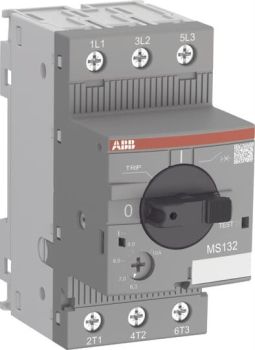
ABB Automation 1SAM350000R1002 MS132-0.25 motor protection switch trip class 10
| Lieske Part No. | 302156 |
|---|---|
| Mfg Part No | 1SAM350000R1002 |
| EAN-Code | 4013614400025 |
| Manufacturer | ABB |
| Here only | 98,80 EUR
117,57 EUR incl. VAT
|
Further information for ABB Automation 1SAM350000R1002 MS132-0.25 motor protection switch trip class 10
| General | |
| Overload release current setting | 0.25 |
| Adjustment range undelayed short-circuit release | 3.1 |
| Switch off technique | Thermomagnetic |
| Rated operating voltage | 690 |
| Rated permanent current Iu | 0.25 |
| Rated operation power at AC-3, 230 V | 0.06 |
| Rated operation power at AC-3, 400 V | 0.06 |
| Type of electrical connection of main circuit | Screw connection |
| Type of control element | Other |
| Device construction | Complete device in housing |
| Number of poles | 3 |
| Rated short-circuit breaking capacity lcu at 400 V, AC | 100 |
| Degree of protection (IP) | IP20 |
| Height | 90 |
| Width | 45 |
| Depth | 86.75 |
| Power loss | 4.8 |
| With thermal protection | |
| Phase failure sensitive | |
| With integrated auxiliary switch | |
| With integrated under voltage release | |
Motor protection switch with thermal and magnetic tripping technology provides reliable protection. The thermal tripping mechanism responds to continuous overloads, with the current setting fixed at 0.25 A. The tripping class is 10, meaning the switch trips within 10 seconds at a current of 10 times the rated current. The instantaneous short-circuit tripping mechanism has an adjustable range of 3.1 times the rated current, enabling rapid response to sudden current surges. The tripping technology is thermomagnetic, combining thermal and electromagnetic responses.
Temperature compensation ensures that the tripping function remains constant regardless of ambient temperature. This prevents false tripping due to temperature fluctuations during operation. Operation is performed via a rotary handle, clearly indicating the switch positions I (On), TRIP (tripped), and 0 (Off). The 0 position can be directly locked with a padlock, enabling secure shutdown and locking during standstill.
Short-circuit indication is integrated, allowing the operator to determine whether the switch tripped due to a short circuit. This supports fault diagnosis during operation. The device is rated for a nominal operating voltage of 690 V and has a nominal continuous current Iu of 0.25 A. The nominal operating power is 0.06 kW at 230 V and 400 V (AC-3). The rated ultimate short-circuit breaking current Icu is 100 kA at 400 V, ensuring high safety during short-circuit events.
Connection type in the main current circuit is via screw connection. The device is supplied as a complete unit in an enclosure, with no integrated auxiliary switches or undervoltage release mechanisms. The protection rating is IP20, providing protection against touch with fingers and against solid foreign objects larger than 12.5 mm. The device is intended for use in enclosed enclosures, not for outdoor applications.
Accessories and extensions can be added as required. These include non-coded auxiliary contacts (MSMNO) and auxiliary contacts with screw (MSMN), suitable for connection to other components. Auxiliary, signal, and short-circuit alarm contacts, as well as undervoltage and operating current release mechanisms, can be mounted without tools. The power loss is 4.8 W.
Applications include motor protection in industrial installations, particularly in enclosures. The MS132 series is suitable for use in Ex zones with ATEX certification, enabling use in explosive environments. UL approval as a “Self protected combination motor controller” extends the application range to North America. The device design is intended for installation in enclosures, with 3-phase rails for 65 A or 100 A and feed blocks for 25 mm² or 35 mm² enabling common feeding of multiple switches. Enclosure housings and accessories for door mounting complement the range.
Mounting and installation are performed via screw connection in the main current circuit. Mounting in enclosures is standardised, with the module width of 45 mm facilitating integration into existing control systems. Operation is via the rotary handle, which can also be used for locking in the 0 position.
Operational advantages include reliable protection, clear indication of switch position, and the ability to lock directly in the 0 position. The temperature-compensated tripping function ensures consistent performance regardless of environmental conditions. The high short-circuit breaking capacity provides safety during sudden current surges. The expandability through accessories allows flexible adaptation to specific requirements in plant operation.

This is an offer of:
79279 Vörstetten
https://industry-electronics.com
Tel. 07666/88499-0
Fax. 07666/88499-111
Diesen Artikel finden Sie unter:
industry-electronics.com/artikel/302156

Lieske Elektronik e.K.
Reutener Str. 1079279 Vörstetten
https://industry-electronics.com
Tel. 07666/88499-0
Fax. 07666/88499-111
Diesen Artikel finden Sie unter:
industry-electronics.com/artikel/302156