
ABB Automation 1SAM250000R1004 MS116-0.63 motor protection switch 0.4-0.63A
Industrial Material > Control devices / Pilot devices > Motor protection switch
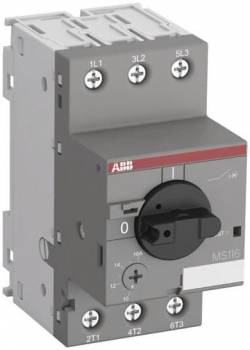
ABB Automation 1SAM250000R1004 MS116-0.63 motor protection switch 0.4-0.63A
| Lieske Part No. | 342618 |
|---|---|
| Mfg Part No | 1SAM250000R1004 |
| EAN-Code | 4013614320279 |
| Manufacturer | ABB |
| Here only | 79,52 EUR
94,63 EUR incl. VAT
|
Further information for ABB Automation 1SAM250000R1004 MS116-0.63 motor protection switch 0.4-0.63A
| General | |
| Overload release current setting | 0.63 |
| Adjustment range undelayed short-circuit release | 7.9 |
| Switch off technique | Thermomagnetic |
| Rated operating voltage | 690 |
| Rated permanent current Iu | 0.63 |
| Rated operation power at AC-3, 230 V | 0.18 |
| Rated operation power at AC-3, 400 V | 0.18 |
| Type of electrical connection of main circuit | Screw connection |
| Type of control element | Other |
| Device construction | Complete device in housing |
| Number of poles | 3 |
| Rated short-circuit breaking capacity lcu at 400 V, AC | 100 |
| Degree of protection (IP) | IP20 |
| Height | 90 |
| Width | 45 |
| Depth | 85.6 |
| Power loss | 5.1 |
| With thermal protection | |
| Phase failure sensitive | |
| With integrated auxiliary switch | |
| With integrated under voltage release | |
Motor protection switch with thermal-magnetic tripping technology ensures reliable disconnection in case of overload (thermal tripping) and sudden short circuits (magnetic tripping). The current setting of the overload tripping unit is 0.63 A, with the instantaneous short-circuit tripping range set at 7.9. The rated operational voltage is 690 V, and the rated continuous current Iu is specified as 0.63 A. The rated operational power at AC-3 is 0.18 kW at both 230 V and 400 V.
Thermal protection is integrated and temperature-compensated, meaning the tripping function remains stable regardless of ambient temperatures. This increases the reliability of the device in various operating environments. The switching position is indicated via a rotary handle with clear markings for I (On) and 0 (Off). The rotary handle can be locked in the 0 position using a locking device to prevent accidental switching on.
Protection class IP20 means the device is protected against contact with fingers and against solid foreign objects up to 12.5 mm in size. It is not intended for outdoor use or in damp environments. The main circuit connection is made via screw terminals. The device is supplied as a complete unit in its housing and does not include integrated auxiliary switches or undervoltage release. These functions can be optionally added with accessories.
Compatibility and accessories include various expansion options. Suitable accessories include padlocks, extractors with and without coding, compatible with MS 116, MS 225, and MS 325 switches. These components enable secure and flexible integration into existing control systems. Mounting is done on 3-phase rails rated for 65 A or 100 A, as well as feed blocks for cross-sections of 25 mm² or 35 mm², allowing common feeding of multiple motor protection switches. Enclosure housings and accessories for enclosure and door mounting complete the range.
Mounting and installation take place in enclosures, where the modular width of 45 mm allows flexible positioning. The screw terminals are designed for secure connections. The power loss is 5.1 W, which should be considered when planning cooling and heat dissipation in the control system. The rated short-circuit breaking capacity Icu is 100 kA at 400 V, AC, highlighting the device's performance under high short-circuit currents.
Operational advantages include a combination of compact design, high reliability, and easy handling. The clear switching position indication and the locking capability enhance safety. Modular expandability via accessories allows adaptation to specific requirements. The device is suitable for use in industrial installations with motors up to 15 kW, where thermal and magnetic tripping technology provides precise protection. The number of poles is 3, corresponding to standard applications in three-phase networks.

This is an offer of:
79279 Vörstetten
https://industry-electronics.com
Tel. 07666/88499-0
Fax. 07666/88499-111
Diesen Artikel finden Sie unter:
industry-electronics.com/artikel/342618

Lieske Elektronik e.K.
Reutener Str. 1079279 Vörstetten
https://industry-electronics.com
Tel. 07666/88499-0
Fax. 07666/88499-111
Diesen Artikel finden Sie unter:
industry-electronics.com/artikel/342618