
ABB Automation 1SAM201904R1005 UA1-230 undervoltage release 230 V
Industrial Material > Control devices / Pilot devices > Motor protection switch
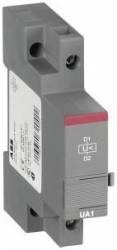
ABB Automation 1SAM201904R1005 UA1-230 undervoltage release 230 V
| Lieske Part No. | 362632 |
|---|---|
| Mfg Part No | 1SAM201904R1005 |
| EAN-Code | 4013614320460 |
| Manufacturer | ABB |
| Here only | 49,59 EUR
59,01 EUR incl. VAT
|
Further information for ABB Automation 1SAM201904R1005 UA1-230 undervoltage release 230 V
| General | |
| Rated control supply voltage Us at AC 50HZ | 230 |
| Rated control supply voltage Us at AC 60HZ | 240 |
| Voltage type for actuating | AC |
| Type of electric connection | Screw connection |
| Number of contacts as normally open contact | 0 |
| Number of contacts as normally closed contact | 0 |
| Number of contacts as change-over contact | 0 |
| Delayed | |
| Suitable for power circuit breaker | |
| Suitable for off-load switch | |
| Suitable for motor safety switch | |
| Suitable for overload relay | |
Applications
The UA1-230 is specifically designed for use with motor protection switches. It is employed in installations where interruption of power supply could lead to unwanted operation or damage, for example in production plants, pump stations, or ventilation systems. The function of the undervoltage release ensures that the connected load is automatically disconnected when the voltage drops below the operating level. This protects electrical components and prevents uncontrolled restarts after voltage recovery.
Functions and Equipment in Detail
The release features a screw connection for electrical connection, ensuring a robust and reliable installation. It does not have contacts as make, break, or changeover contacts, as its function is solely based on tripping under undervoltage conditions and does not perform any additional switching functions. The tripping is not delayed, meaning the release reacts immediately as soon as the voltage falls below the predefined value. This is crucial for applications requiring immediate disconnection to avoid damage.
Technology Explained Simply
The UA1-230 continuously monitors the applied voltage. When this voltage drops below the rated value of 230 V (50 Hz) or 240 V (60 Hz), the release is activated and triggers the disconnection of the motor protection switch. The use of alternating current (AC) as the operating voltage is typical for industrial applications, as these are generally powered by AC networks. The screw connection ensures a mechanically stable and electrically reliable connection, even under industrial conditions.
Compatibility and Accessories
The undervoltage release is exclusively suitable for motor protection switches. It is not intended for use with power circuit breakers, load switches, or overload relays. Mounting is on the left side of the main units, enabling standardized and uniform installation.
Mounting and Installation
Mounting is directly onto the motor protection switch, with the position specified as left side. The electrical connection is made via screw terminals, enabling simple and secure installation. Installation must follow the manufacturer’s technical specifications to ensure correct functionality.
Advantages in Operation
The immediate response to undervoltage conditions protects connected devices and prevents unwanted operating states. Use in combination with motor protection switches enables precise and reliable control of the system. Compatibility with different network frequencies (50 Hz and 60 Hz) extends the device’s application range in international installations. The robust construction and screw connection ensure long-term, low-maintenance operation in industrial environments.

This is an offer of:
79279 Vörstetten
https://industry-electronics.com
Tel. 07666/88499-0
Fax. 07666/88499-111
Diesen Artikel finden Sie unter:
industry-electronics.com/artikel/362632
Lieske Elektronik e.K.
Reutener Str. 1079279 Vörstetten
https://industry-electronics.com
Tel. 07666/88499-0
Fax. 07666/88499-111
Diesen Artikel finden Sie unter:
industry-electronics.com/artikel/362632