
ABB Automation 1SAE231111R0722 heating contactor 2S/2Ö
Installation > Modular devices / equipment installation > Heating contactor
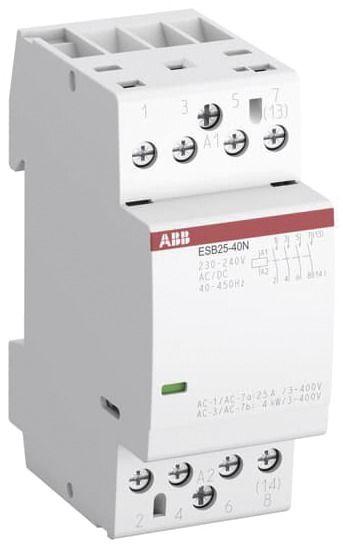
ABB Automation 1SAE231111R0722 heating contactor 2S/2Ö
| Lieske Part No. | 1101489 |
|---|---|
| Mfg Part No | 1SAE231111R0722 |
| EAN-Code | 4013614517990 |
| Manufacturer | ABB |
| Here only | 101,65 EUR
120,96 EUR incl. VAT
|
Further information for ABB Automation 1SAE231111R0722 heating contactor 2S/2Ö
| General | |
| Rated operating voltage | 400 |
| Rated operation current | 25 |
| Rated excitation voltage | 415 |
| Voltage type (operating voltage) | AC/DC |
| Voltage type (excitation voltage) | AC/DC |
| Number of contacts as normally open contact | 2 |
| Number of contacts as normally closed contact | 2 |
| Built-in depth | 58 |
| Degree of protection (IP) | IP20 |
| Width in number of modular spacings | 2 |
| Slider for hand switch | |
| Additional equipment possible | |
| With day/night function | |
Installation contactor with 4-pole configuration and 2S/2Ö contact configuration (two normally open contacts, two normally closed contacts) provides a clear and reliable switching function. The integrated coil wiring ensures that the device can be operated with both alternating and direct current. As a result, the contactor is completely noise-free and operates quietly, which is particularly advantageous in residential and office buildings. The mounting depth is 58 mm, and the width corresponds to 2 module units (36 mm), enabling compact installation in standard distribution boxes. The protection rating IP20 protects against finger contact and solid foreign objects, but is not suitable for outdoor use or in damp environments.
Functions and equipment in detail include the possibility of attaching additional components such as auxiliary switches or sealing caps. These can be mounted on the left side of the device and serve to extend functionality, for example for signal transmission or protection against unauthorized manipulation. The devices are not equipped with a manual operation slide, meaning they can only be operated via electrical control.
Technology explained simply shows that the integrated coil wiring enables the use of both AC and DC voltages without requiring additional components. This reduces installation complexity and increases reliability, as no additional circuits or converters are needed. The switching function is performed via mechanical contacts, which open or close the circuit when the coil is energized. The contact configuration 2S/2Ö allows parallel control of multiple loads or feedback of switching states.
Compatibility and accessories include suitable extensions such as the sealing cap ESB-PLK24, which protects the device against unauthorized opening, and the auxiliary contact block EH04-11N with a contact configuration of 1S/1Ö. These accessories can be mounted additionally to realize additional functions such as status indication or remote control. The devices are designed for mounting in standard distribution boxes and can be combined with other devices from the ESB25 series.
Mounting and installation is carried out in standard distribution boxes with a width of 2 module units (36 mm). The mounting depth of 58 mm must be considered when planning the depth of the distribution box. Mounting is done using screw fastening, with no special tools or additional components required. Electrical connections are made via the designated terminal clamps, which are rated for the operating voltage and current.
Advantages in operation include quiet and hum-free switching, universal operating voltage (AC/DC), and compact design. Compliance with standard EN61095 ensures safe and reliable operation in household and small-scale applications. The ability to integrate accessories such as auxiliary switches or sealing caps extends functionality without requiring additional components in the distribution box. The device is therefore particularly suitable for applications where clear, reliable, and low-maintenance control of electrical loads is required.

This is an offer of:
79279 Vörstetten
https://industry-electronics.com
Tel. 07666/88499-0
Fax. 07666/88499-111
Diesen Artikel finden Sie unter:
industry-electronics.com/artikel/1101489

Lieske Elektronik e.K.
Reutener Str. 1079279 Vörstetten
https://industry-electronics.com
Tel. 07666/88499-0
Fax. 07666/88499-111
Diesen Artikel finden Sie unter:
industry-electronics.com/artikel/1101489