
WAGO 282-907 Protective Conductor Terminal 0.2–6 mm² green-yellow
Industrial Material > Connection technology > Terminals
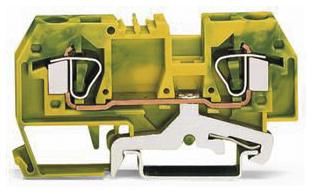
WAGO 282-907 Protective Conductor Terminal 0.2–6 mm² green-yellow
| Lieske Part No. | 790521 |
|---|---|
| Mfg Part No | 282-907 |
| EAN-Code | 4044918471794 |
| Manufacturer | WAGO |
| Here only | 5,03 EUR
5,99 EUR incl. VAT
|
Further information for WAGO 282-907 Protective Conductor Terminal 0.2–6 mm² green-yellow
| General | |
| Product type | 2-wire earth conductor terminal |
| Protective conductor colour | Green-yellow |
| Maximum conductor cross-section | 6 mm² |
| Minimum conductor cross-section | 0,2 mm² |
| Rail width | 35 mm |
| DIN rail height | 7,5 mm |
| Stripping length | 12-13 mm |
| Technology | CAGE CLAMP® |
| Actuation | Via actuation tool |
| Text | Centrical |
| Terminal type | through-feed terminal block |
Applications
The protective earth terminal block is used in electrical installations where secure earthing is required, for example in enclosures, distribution boxes, or during the installation of machines and equipment. It ensures a stable electrical connection between the protective earth conductor and the support rail, thereby providing reliable protection against touch voltages. The terminal block is designed for use in industrial environments where high mechanical loads and high reliability requirements exist.
Functions and Equipment in Detail
The terminal block features CAGE CLAMP® technology, enabling universal connection for various types of conductors. The cage spring ensures a secure and lasting contact without requiring prior treatment of the conductor, such as crimping wire end ferrules. The stripping length for conductor connection is between 12 and 13 mm. The terminal block is designed as a pass-through terminal block, meaning current flows through the block, and it can be mounted in a row with other terminal blocks.
Technology Explained Simply
CAGE CLAMP® technology works with a cage spring that securely holds the conductor in a cage. During installation, the conductor is inserted into the terminal block and tightened using an actuation tool. The spring ensures that the contact remains stable even under mechanical loads or temperature fluctuations. The integrated contact foot provides direct electrical and mechanical connection to the support rail, enabling earthing directly via the rail. The terminal block is suitable for conductor cross-sections from 0.2 mm² to 6 mm², with a maximum cross-section of 6 mm².
Compatibility and Accessories
The terminal block is compatible with support rails of dimensions 35 x 15 mm and 35 x 7.5 mm. Suitable accessories include, for example, the aluminium support rail 210-196, the steel support rail 210-112, and various labelling systems such as the multilabelling system WMB (e.g. 793-5501, 793-501). Additionally, cross jumpers such as the 282-402 or the warning cover 282-415 are available to complement the installation. The terminal block can be combined with other products from series 282 to create complex connection structures.
Mounting and Installation
Mounting is done onto the support rail using the integrated contact foot. The terminal block is clipped onto the rail and secured by spring force. The conductor is inserted into the terminal block, with a stripping length of between 12 and 13 mm required. Fixing is done using an actuation tool that compresses the cage spring and securely holds the conductor. Installation is carried out in a row, with the terminal block functioning as a pass-through terminal.
Advantages in Operation
The terminal block provides a maintenance-free and reliable connection that remains stable even under high mechanical loads. CAGE CLAMP® technology reduces installation time, as no prior treatment of the conductor is required. The green-yellow colouring and central labelling facilitate identification and documentation of connections. The direct connection to the support rail ensures efficient earthing, increasing the safety of the installation.

This is an offer of:
79279 Vörstetten
https://industry-electronics.com
Tel. 07666/88499-0
Fax. 07666/88499-111
Diesen Artikel finden Sie unter:
industry-electronics.com/artikel/790521

Lieske Elektronik e.K.
Reutener Str. 1079279 Vörstetten
https://industry-electronics.com
Tel. 07666/88499-0
Fax. 07666/88499-111
Diesen Artikel finden Sie unter:
industry-electronics.com/artikel/790521