
WAGO 281-328 End and Intermediate Plate Gray
Industrial Material > Connection technology > Terminals
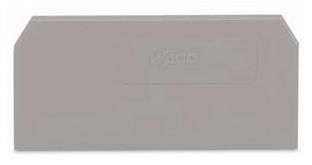
WAGO 281-328 End and Intermediate Plate Gray
| Lieske Part No. | 882678 |
|---|---|
| Mfg Part No | 281-328 |
| EAN-Code | 4017332295550 |
| Manufacturer | WAGO |
| Here only | 0,52 EUR
0,62 EUR incl. VAT
|
Further information for WAGO 281-328 End and Intermediate Plate Gray
| General | |
| Colour | Grey |
| Thickness | 2,5 mm |
End and intermediate plate
The plate functions both as an end plate and as an intermediate plate in terminal block systems. As an end plate, it is mounted at the end of a terminal strip to round off the external contour and provide mechanical protection. As an intermediate plate, it serves for visual and electrical separation between individual terminals, especially when no electrical connection between the terminals is required. The grey colour corresponds to the standard design of WAGO products and ensures a uniform visual appearance in the installation.
Applications
The end and intermediate plate 281-328 is used in industrial electrical installations where terminal blocks are used for connecting wires and cables. It is particularly suitable for plants in the manufacturing industry, automation technology, and machine building, where clear structuring of terminal strips is required. The plate is mounted in enclosures, control systems, and distributors to improve the clarity and maintainability of the installation.
Functions and equipment in detail
The plate is made of a robust, non-conductive material that ensures electrical insulation. Its thickness of 2.5 mm provides sufficient mechanical stability to protect the terminal strip from external influences. The grey colour is a visual feature that identifies the plate as part of the WAGO system. The shape is designed to fit exactly into the mounting openings of the terminal blocks, ensuring secure and clean installation.
Technology explained simply
The function of the plate is based on mechanical and electrical separation within a terminal strip. By using it as an intermediate plate, it prevents wires or cables from being accidentally connected to adjacent terminals, which could lead to short circuits. As an end plate, it protects the end terminal from mechanical damage and prevents dust or moisture from entering the terminal strip. The material selection ensures high insulation capability, which is crucial for safety in electrical installations.
Compatibility and accessories
The end and intermediate plate 281-328 is specifically developed for use with WAGO terminal blocks. It fits into the mounting openings of the corresponding terminal strips and is used in WAGO’s standard and compact systems. The plate is not a standalone electrical component, but complements the terminal function through mechanical and visual separation. It is used in combination with other WAGO products such as terminals, end caps, or markings to achieve a complete and structured installation.
Installation and mounting
Mounting is done by simply inserting the plate into the designated openings of the terminal block. No additional tools or mounting aids are required. The plate fits securely by form-fit and can be removed without tools. Installation typically takes place after mounting the terminals, to complete the external structure of the strip. Positioning is either at the end of the strip (as an end plate) or between individual terminals (as an intermediate plate), depending on the requirements of the installation.
Advantages in operation
Using the end and intermediate plate 281-328 improves the clarity and maintainability of enclosures and control systems. The clear visual separation between terminals facilitates identification and maintenance of individual connections. Mechanical stability protects the terminal strip from damage, and electrical insulation increases the safety of the installation. The simple mounting and dismounting allows for flexible adaptation to changing requirements in operation.

This is an offer of:
79279 Vörstetten
https://industry-electronics.com
Tel. 07666/88499-0
Fax. 07666/88499-111
Diesen Artikel finden Sie unter:
industry-electronics.com/artikel/882678

Lieske Elektronik e.K.
Reutener Str. 1079279 Vörstetten
https://industry-electronics.com
Tel. 07666/88499-0
Fax. 07666/88499-111
Diesen Artikel finden Sie unter:
industry-electronics.com/artikel/882678