
WAGO 270-574 Feed-in Terminal 4-Wire Initiators Orange
Industrial Material > Connection technology > Terminals
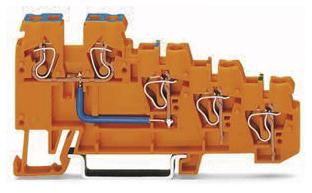
WAGO 270-574 Feed-in Terminal 4-Wire Initiators Orange
| Lieske Part No. | 814233 |
|---|---|
| Mfg Part No | 270-574 |
| EAN-Code | 4045454193829 |
| Manufacturer | WAGO |
| Here only | 45,70 EUR
54,38 EUR incl. VAT
|
Further information for WAGO 270-574 Feed-in Terminal 4-Wire Initiators Orange
| General | |
| Product type | 4-wire initiator feed terminal |
| Current carrying capacity | 9 A |
| Cable cross-section | 0,08-2,5 mm² |
| Colour | Orange |
| Bridging | Internal |
Applications
The terminal block is typically used in control systems, automation systems, and enclosures, where initiators such as limit switches, pushbuttons, or sensors are connected. The 4-wire configuration allows for separate connections of power supply, signal return, and any auxiliary contacts. The internal bridging ensures that electrical connections are automatically established within the terminal block, reducing the number of required external connections. This is particularly advantageous in complex circuits, where clear and organised wiring is essential.
Functions and Features in Detail
The terminal block is rated for a current of up to 9 A, making it suitable for use in medium to high-load applications. The permissible cross-section for connected wires is 0.08 to 2.5 mm², covering a wide range of cable types, from fine signal wires to heavier power conductors. The internal bridging is permanently integrated and requires no additional bridging links, reducing installation time and lowering the risk of errors. The orange colour serves as a visual identifier, allowing for quick recognition of the terminal block within the enclosure.
Technical Explanation
The 4-wire initiator feed-in terminal block operates on the principle of a strip terminal, where individual connections are linked via a common screw connection. The internal bridging establishes a fixed electrical connection between the connection points, eliminating the need for additional cables or bridges. The terminal block is designed for secure and durable connections, with mechanical strength ensured by its construction. The orange colour is a standard in electrical engineering for identifying specific functions or circuits.
Compatibility and Accessories
The terminal block is compatible with various accessories that support labelling and organisation within the enclosure. These include, for example, the Mini-WSB quick labelling system in various colours (red, orange, purple), WMB labels in various colours and sizes, and wire end ferrules for different cable cross-sections. Additionally, comb bridges (5-way and 6-way) can be used to connect multiple terminal blocks. The use of cover profile carriers and end plates enables proper installation and finishing of terminal strip rows.
Mounting and Installation
Mounting is carried out in the usual manner within an enclosure or on a mounting profile. The terminal block is secured using an appropriate actuation tool, such as a partially insulated screwdriver. Wires are inserted into the respective connection openings and tightened by turning the screw. The internal bridging ensures that the electrical connection is automatically established. Labelling of the terminal block can be done using the mentioned accessories to ensure clear identification of connections.
Operational Advantages
The terminal block provides a reliable and secure connection for initiators in industrial installations. The internal bridging reduces the number of required connections and lowers the risk of errors. The colour coding facilitates identification within the enclosure, and compatibility with various labelling systems supports structured and clear wiring. The terminal block is designed for high mechanical load capacity and is suitable for use in demanding environments.

This is an offer of:
79279 Vörstetten
https://industry-electronics.com
Tel. 07666/88499-0
Fax. 07666/88499-111
Diesen Artikel finden Sie unter:
industry-electronics.com/artikel/814233

Lieske Elektronik e.K.
Reutener Str. 1079279 Vörstetten
https://industry-electronics.com
Tel. 07666/88499-0
Fax. 07666/88499-111
Diesen Artikel finden Sie unter:
industry-electronics.com/artikel/814233