
WAGO 2202-1201 Terminal Block 2.5 mm² gray
Industrial Material > Connection technology > Terminals
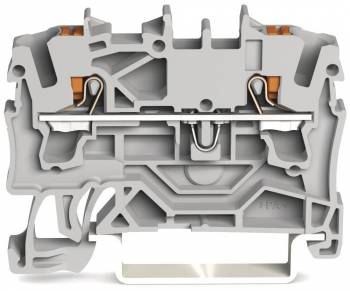
WAGO 2202-1201 Terminal Block 2.5 mm² gray
| Lieske Part No. | 1596615 |
|---|---|
| Mfg Part No | 2202-1201 |
| EAN-Code | 4055143713542 |
| Manufacturer | WAGO |
| Here only | 0,84 EUR
1,00 EUR incl. VAT
|
Further information for WAGO 2202-1201 Terminal Block 2.5 mm² gray
| General | |
| Number of conductors | 2 - |
| Connection technology | Push-in CAGE CLAMP® - |
| Maximum conductor cross-section | 2,5 mm² |
| Test opening | Yes - |
| Text | laterally and centrally - |
| DIN rail | 35 x 15 mm and 35 x 7.5 mm - |
| Colour | Grey - |
| Explosion safety | Ex e II - |
| Actuator | Yes - |
Applications
This terminal block is suitable for use in industrial electrical installations, particularly in environments subject to explosion protection category Ex e II. It is appropriate for connecting conductors in enclosures, control systems, and distributors where a secure and durable connection is required. Its use on standard support rails ensures compatibility with a wide range of enclosure configurations.
Functions and Equipment in Detail
The 2-wire passage terminal block 2202-1201 enables the connection of two conductors at a single connection point. The integrated pusher facilitates installation and ensures a secure connection. The test opening allows inspection of the connection during operation without disassembling the terminal block. Labeling options on the side and in the center support clear identification, simplifying maintenance and fault diagnosis. The Push-in CAGE CLAMP® system enables quick and tool-free connections, reducing installation time.
Technology Explained Simply
The Push-in CAGE CLAMP® system operates with a spring-loaded clamping mechanism that automatically secures the conductor once inserted into the terminal block. The pusher serves as an aid to press the conductor securely into the terminal block. The test opening is an additional connection point that allows electrical connection to be checked with a measuring device without opening the terminal block. The protection type Ex e II means the terminal block is suitable for use in areas where explosion hazards exist due to flammable gases or vapors, and meets the requirements for electrical safety.
Compatibility and Accessories
The terminal block is designed for mounting on support rails with dimensions 35 x 15 mm and 35 x 7.5 mm, ensuring high compatibility with common enclosure systems. As accessories, various labeling systems are available, including the WMB multilabeling system in different colors and the Mini-WSB quick labeling system. Additionally, wire end ferrules for different cross-sections (0.5 mm², 0.75 mm², 1 mm², 1.5 mm²) can be used to optimize the connection. Fork bridges and box bridges in various designs enable connection of multiple terminals. Test probes and group label holders support maintenance and identification.
Mounting and Installation
Mounting is done by inserting the terminal block into the support rail, where the shape of the rail secures the block in place. The conductor connection is tool-free via the Push-in CAGE CLAMP® system. The pusher is used to press the conductor securely into the terminal block. Labeling can be done directly on the terminal block, with side and central labeling options enabling flexible identification.
Operational Advantages
The terminal block provides a fast and reliable connection that can be installed without tools. The test opening allows for easy inspection of the connection during operation, simplifying maintenance and fault diagnosis. Compatibility with various support rails and a wide range of accessories increases installation flexibility. The Ex e II approval expands the application range to potentially explosive environments.

This is an offer of:
79279 Vörstetten
https://industry-electronics.com
Tel. 07666/88499-0
Fax. 07666/88499-111
Diesen Artikel finden Sie unter:
industry-electronics.com/artikel/1596615

Lieske Elektronik e.K.
Reutener Str. 1079279 Vörstetten
https://industry-electronics.com
Tel. 07666/88499-0
Fax. 07666/88499-111
Diesen Artikel finden Sie unter:
industry-electronics.com/artikel/1596615