
VIPA 972-0DP10 Profibus Connector 90° PG Socket
Industrial Material > Automation > PLC Systems
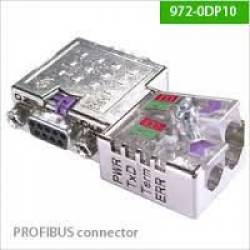
VIPA 972-0DP10 Profibus Connector 90° PG Socket
| Lieske Part No. | 593194 |
|---|---|
| Mfg Part No | 972-0DP10 |
| EAN-Code | |
| Manufacturer | VIPA |
| Here only | 59,65 EUR
70,98 EUR incl. VAT
|
Further information for VIPA 972-0DP10 Profibus Connector 90° PG Socket
| General | |
| Clock rate | 12 Mbit/s |
| Diagnostic function | via LEDs |
| Cable branching | 90° |
| Connection type | 9-pin Sub-D male connector |
| Connection socket | PG socket |
Applications
The PROFIBUS connector is used in industrial automation systems where a stable and diagnostic-capable connection between controllers and peripheral devices is required. It is suitable for applications in manufacturing automation, machine building and process control, where high mechanical loads and environmental conditions such as dust or moisture prevail. The integrated diagnostic function via LEDs enables quick fault detection during operation without requiring additional measuring devices.
Functions and Equipment in Detail
A central feature of the VIPA 972-0DP10 is the integrated, switchable termination resistor, which is accessible from both sides via a sliding switch. This resistor can be activated or deactivated to adapt the network configuration to the respective topology. Termination resistors are required for end devices in the PROFIBUS network to avoid signal reflections. The diagnostic function is implemented via four LEDs indicating the operating status: power supply, bus activity, fault condition, and termination status. The LEDs enable visual monitoring of the network status without additional diagnostic devices.
Technology Explained Simply
The connector is equipped with a 9-pin Sub-D male connector (SPE) that connects to the PROFIBUS line. The connection is made via a quick, insulating clamp technology that ensures a secure and durable connection. The cable connection is made via a 90° branch, directing the cable vertically out of the connector. The housing is made of galvanized steel sheet and offers IP20 protection, suitable for use in enclosed enclosures. The operating voltage is supplied by the end device, requiring a voltage of 4.75 to 5.25 V DC. The current consumption is between 10 and 30 mA.
Compatibility and Accessories
The VIPA 972-0DP10 is compatible with PROFIBUS-DP networks and can be connected to various PROFIBUS cables, including flexible cables such as UNITRONIC BUS PB FD P 1x2x0,64 PROFIBUS DP PUR violet (article number 2170222). The cable connection is made via the integrated clamp technology, supporting cable diameters up to 8 mm. The connection technique requires stripping the cable and inserting the conductors into the designated nozzles, with special care needed to avoid short circuits between the conductors and the housing.
Mounting and Installation
Mounting is done using a single screw (M3x15) in the enclosure, with the housing equipped with a release-protected single-screw mounting. The mounting is done in a 90° position, directing the cable vertically out of the connector. The cable connection is made via the insulating clamps, supporting cable diameters up to 8 mm. The installation instructions in the datasheet describe the steps for cable connection, including stripping the cable, inserting the conductors into the nozzles, and screwing on the contact cover.
Advantages in Operation
The VIPA 972-0DP10 offers a reliable and maintenance-friendly connection in the PROFIBUS network. The integrated diagnostic function via LEDs enables quick fault detection, increasing the operational uptime of the system. The switchable termination resistor allows flexible network configuration without requiring additional components. The metallic housing provides mechanical protection and is designed for use in industrial environments. The 90° cable branch simplifies cable routing in the enclosure and reduces the risk of cable damage due to mechanical stress.

This is an offer of:
79279 Vörstetten
https://industry-electronics.com
Tel. 07666/88499-0
Fax. 07666/88499-111
Diesen Artikel finden Sie unter:
industry-electronics.com/artikel/593194

Lieske Elektronik e.K.
Reutener Str. 1079279 Vörstetten
https://industry-electronics.com
Tel. 07666/88499-0
Fax. 07666/88499-111
Diesen Artikel finden Sie unter:
industry-electronics.com/artikel/593194