
VDE-Kabel 248674 NYCWY 4x120 mm² Earth Cable
Cables > Underground cables > Copper-Underground-Cables NYCY / NYCWY
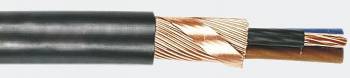
VDE-Kabel 248674 NYCWY 4x120 mm² Earth Cable
| Lieske Part No. | 103646 |
|---|---|
| Mfg Part No | 248674 |
| EAN-Code | 4018730152506 |
| Manufacturer | VDE-Kabel |
| Here only | 79,20 EUR
94,25 EUR incl. VAT
|
Further information for VDE-Kabel 248674 NYCWY 4x120 mm² Earth Cable
| General | |
| Nominal voltage | 0,6/1 kV |
| Test voltage | 4 kV |
| Operation temperature | +70 °C |
| Installation temperature range | -5 to +50 °C |
| Temperature range after installation | -30 to +70 °C |
| Bending radius | 12 x cable diameter |
| Flame retardancy | according to VDE 0472 T. 804, test type B (IEC 332-1) |
| Conductor type | sector-shaped stranded (SM) |
| Wire insulation | PVC |
| Outer sheath | PVC black |
| Concentric conductor | made of bare copper wires, braided with copper tape |
| Conductor marking | according to VDE 0293-308 |
| Conductor material | bare copper in accordance with VDE 0295 |
Applications
This cable is designed for use in industrial plants, power plants, and distribution networks where high requirements for electrical safety and mechanical stability apply. It is particularly used in applications demanding high reliability and long-term durability of the cable connection. Installation takes place in cable trenches, underground, indoors, or in cable ducts, with the PVC insulation and black-colored outer sheath providing high resistance to environmental influences.
Functions and Equipment in Detail
The conductor consists of bare copper in accordance with VDE 0295, with a sector-shaped stranded (SM) design. This ensures optimal current conduction and mechanical stability. The core insulation is made of PVC, with core identification according to VDE 0293-308. A filler layer ensures even distribution of cores within the cable cross-section. A concentric conductor made of bare copper wires, helically stranded around the common core sheath, and supplemented with a counter-twist of copper tape (copper wires in the inner layer, copper tape in the outer layer), provides additional protection against electrical interference and enables efficient earthing.
Technology Explained Simply
The cable’s construction with a concentric conductor ensures improved shielding and secure earthing, which is particularly advantageous in installations with high safety requirements. The black PVC outer sheath protects the cable against mechanical damage, UV radiation, and moisture. The rated voltage is 0.6/1 kV, sufficient for most industrial applications. The test voltage of 4 kV ensures electrical strength. The maximum operating temperature is +70 °C, with the cable tolerating installation temperatures from –5 °C to +50 °C and post-installation temperatures from –30 °C to +70 °C. The bending radius is 12 times the cable diameter, enabling flexible installation. Flame retardancy according to VDE 0472 Part 804, test method B (equivalent to IEC 332-1), ensures limited flame spread in case of fire.
Compatibility and Accessories
Compatible accessories are available for this cable, such as the sleeve VHR1204, specifically designed for compacted conductors made of E-Cu galvanized. This sleeve can be used during installation for secure connection and protection of cable ends.
Installation and Mounting
Installation involves laying the cable outdoors, underground, indoors, or in cable ducts. The laying must respect the bending radius of 12 times the cable diameter to avoid mechanical damage. Temperature conditions during laying (–5 °C to +50 °C) and after laying (–30 °C to +70 °C) must be observed to ensure functionality and service life of the cable.
Operational Advantages
The cable offers high electrical and mechanical stability, secure earthing via the concentric conductor, and good resistance to environmental influences. The PVC insulation and black-colored outer sheath ensure long service life and low maintenance requirements. Flame retardancy according to VDE 0472 Part 804, test method B, increases operational safety, especially in enclosed spaces or areas with increased fire risk. The sector-shaped conductor design (SM) enables efficient current transmission and reduces mechanical stresses within the cable cross-section.

This is an offer of:
79279 Vörstetten
https://industry-electronics.com
Tel. 07666/88499-0
Fax. 07666/88499-111
Diesen Artikel finden Sie unter:
industry-electronics.com/artikel/103646

Lieske Elektronik e.K.
Reutener Str. 1079279 Vörstetten
https://industry-electronics.com
Tel. 07666/88499-0
Fax. 07666/88499-111
Diesen Artikel finden Sie unter:
industry-electronics.com/artikel/103646