
VDE-Kabel 248537 NYCWY 4x70 SM/35 Earth Cable
Cables > Underground cables > Copper-Underground-Cables NYCY / NYCWY
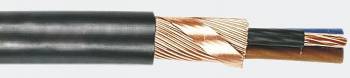
VDE-Kabel 248537 NYCWY 4x70 SM/35 Earth Cable
| Lieske Part No. | 468698 |
|---|---|
| Mfg Part No | 248537 |
| EAN-Code | 4018730152483 |
| Manufacturer | VDE-Kabel |
| Here only | 45,68 EUR
54,36 EUR incl. VAT
|
Further information for VDE-Kabel 248537 NYCWY 4x70 SM/35 Earth Cable
| General | |
| Nominal voltage | 0,6/1 kV |
| Test voltage | 4 kV |
| Operation temperature | +70 °C |
| Installation temperature range | -5 to +50 °C |
| Temperature range after installation | -30 to +70 °C |
| Bending radius | 12 x cable diameter |
| Flame retardancy | According to VDE 0472 T. 804 test type B (IEC 332-1) |
| Conductor type | sector-shaped stranded (SM) |
| Conductor material | Plain copper |
| Insulating material | PVC |
| Conductor marking | according to VDE 0293-308 |
| Outer sheath | PVC black |
| Concentric conductor | made of bare copper wires with counter-winding of copper tape |
Applications
This cable is designed for use in industrial and power engineering applications, particularly where high mechanical and electrical load capacity as well as protection against contact voltage are required. It is suitable for installation underground, in cable ducts, indoors, and outdoors. Its use in power plants and local networks highlights the reliability and high safety requirements placed on this cable.
Functions and Equipment in Detail
The conductor is made of bare copper according to VDE 0295, with a sector-shaped stranded (SM) design. The cores are insulated with PVC and marked according to VDE 0293-308, enabling clear identification of individual cores. A filler layer ensures even distribution of cores within the cable cross-section. The concentric conductor, made of bare copper wires, is helically stranded around the common core sheath and equipped with a counter-twist made of copper tape. The inner layer consists of copper wires, while the outer layer is made of copper tape, providing effective shielding and mechanical stability. The outer sheath is made of black PVC, offering high mechanical strength and weather resistance.
Technology Explained Simply
The sector-shaped conductor design (SM) enables a compact cross-section, ensuring even current distribution and low inductance at high current levels. The PVC insulation provides high electrical insulation and is resistant to moisture and mechanical stress. The concentric conductor serves as a protective conductor and improves earthing properties, enhancing safety against contact voltage. The combination of copper wires and copper tape in the concentric conductor ensures high mechanical strength and efficient shielding. The black-colored PVC outer sheath protects the cable from external influences such as moisture, UV radiation, and mechanical stress.
Compatibility and Accessories
For connecting and securing the cable, special connectors are suitable, such as the VHR704 connector 70 mm² for compacted conductors E-Cu galvanized. This connector is designed for use with compacted copper conductors and ensures a secure and durable connection. The use of appropriate connection elements is crucial for the electrical and mechanical reliability of the installation.
Installation and Mounting
Mounting the cable requires adherence to the specified bending radius of 12 times the cable diameter to avoid mechanical damage. Installation typically occurs underground, in cable ducts, or indoors. Temperature conditions during installation (–5 °C to +50 °C) and after installation (–30 °C to +70 °C) must be considered to ensure proper function and long service life. Flame retardancy according to VDE 0472 Part 804, test method B (IEC 332-1), requires compliance with relevant fire protection regulations during installation.
Operational Advantages
The cable offers high electrical and mechanical strength, making it suitable for demanding industrial and power engineering applications. The sector-shaped conductor design ensures optimal current distribution and low inductance. The concentric conductor improves earthing properties and enhances safety against contact voltage. The PVC insulation and black-colored outer sheath provide high resistance to moisture, UV radiation, and mechanical stress. Flame retardancy according to VDE 0472 Part 804, test method B (IEC 332-1), ensures limited flame spread in case of fire, increasing operational safety.

This is an offer of:
79279 Vörstetten
https://industry-electronics.com
Tel. 07666/88499-0
Fax. 07666/88499-111
Diesen Artikel finden Sie unter:
industry-electronics.com/artikel/468698

Lieske Elektronik e.K.
Reutener Str. 1079279 Vörstetten
https://industry-electronics.com
Tel. 07666/88499-0
Fax. 07666/88499-111
Diesen Artikel finden Sie unter:
industry-electronics.com/artikel/468698