
Theben 4942542 EU 1 KNX radio actuator 1-way
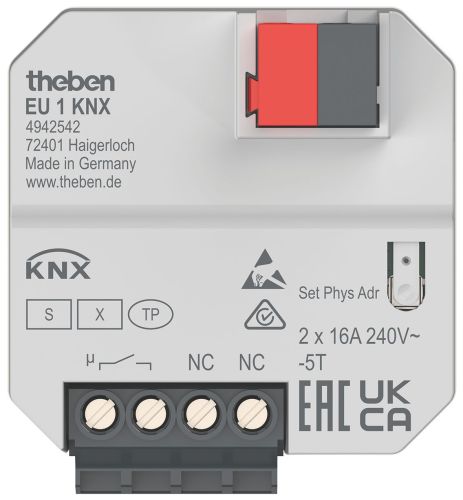
Theben 4942542 EU 1 KNX radio actuator 1-way
| Lieske Part No. | 871643 |
|---|---|
| Mfg Part No | 4942542 |
| EAN-Code | 4003468491850 |
| Manufacturer | Theben |
| Here only | 155,61 EUR
185,18 EUR incl. VAT
|
Further information for Theben 4942542 EU 1 KNX radio actuator 1-way
| General | |
| Product type | KNX 1-channel wireless electro-heating actuator UP |
| Manufacturer | Theben |
| Number of binary inputs | 2 |
| Function | Additional stage |
| Safety function | KNX Data Secure |
| Integrated function | Temperature controller |
| Connection option | Floor sensor |
| Housing shape | Compact |
Applications
The EU 1 KNX is suitable for use in residential and commercial buildings where decentralized, network-based heating control is required. It is typically used in rooms with electric heaters, especially in systems requiring high switching capacity. The direct control of heaters without additional relays or converters makes it particularly suitable for installations with high power requirements. Support for KNX Data Secure ensures secure commissioning and communication within the network, which is important for use in sensitive environments.
Functions and Equipment in Detail
The actuator features two binary inputs, which can be used for potential-free contacts such as push buttons, switches, or window contacts. These inputs allow integration of user interactions or environmental conditions into the heating control. Additionally, a floor sensor can be directly connected to accurately measure room temperature and adjust heating output accordingly. The auxiliary stage function allows simple control of a second heat source, increasing system flexibility and enabling efficient load distribution.
Technology Explained Simply
The EU 1 KNX is a wireless actuator that communicates via the KNX protocol. The term wireless refers to wireless communication within the KNX network, with data transmission carried out via wireless modules. Support for KNX Data Secure ensures encrypted and authenticated communication, enhancing the security of the control system. The integrated temperature controller enables automated regulation of heating output based on measured room temperature. Direct control of electric heaters with high switching capacity is achieved through a robust switching mechanism designed for the required load.
Compatibility and Accessories
The actuator is compatible with the KNX standard and can be integrated into existing KNX installations. The direct connection capability for a floor sensor and the two binary inputs allow combination with various sensors and switches. The auxiliary stage function enables control of a second heat source, making the system suitable for complex heating concepts. The use of KNX Data Secure ensures interoperability with other KNX devices that comply with security standards.
Mounting and Installation
Mounting is facilitated by the particularly compact housing, which allows easy installation in standard distribution boxes. Connection options are clearly structured, with direct connections to electric heaters, floor sensors, and binary inputs without requiring additional adapters or converters. Installation does not require special tools or additional components, as all necessary connections are directly available on the device.
Advantages in Operation
Operation of the EU 1 KNX is characterized by integrated temperature control and direct switching capability for high power loads. Support for KNX Data Secure ensures secure communication, protecting against unauthorized access. The ability to use a floor sensor and two binary inputs increases system flexibility and responsiveness. The auxiliary stage function enables efficient use of multiple heat sources, potentially improving energy efficiency. The compact design simplifies installation and reduces space requirements in the distribution box.

This is an offer of:
79279 Vörstetten
https://industry-electronics.com
Tel. 07666/88499-0
Fax. 07666/88499-111
Diesen Artikel finden Sie unter:
industry-electronics.com/artikel/871643

Lieske Elektronik e.K.
Reutener Str. 1079279 Vörstetten
https://industry-electronics.com
Tel. 07666/88499-0
Fax. 07666/88499-111
Diesen Artikel finden Sie unter:
industry-electronics.com/artikel/871643