
Telegärtner L00000A0149 patch cable CAT7 1.0 m green
Cables > Data lines > Cat7 Patch Cables
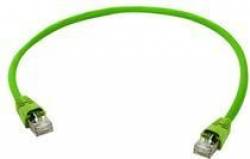
Telegärtner L00000A0149 patch cable CAT7 1.0 m green
| Lieske Part No. | 237767 |
|---|---|
| Mfg Part No | L00000A0149 |
| EAN-Code | 4018359317614 |
| Manufacturer | Telegärtner |
| Here only | 5,56 EUR
6,61 EUR incl. VAT
|
Further information for Telegärtner L00000A0149 patch cable CAT7 1.0 m green
| General | |
| Cable type | Patch cable |
| Category | Cat7 |
| Bandwidth | 500 MHz |
| Shielding | S-STP(S/FTP) |
| Insulating material | PUR |
| Operation temperature | 75 °C |
| Degree of protection | IP20 |
| Cable colour | Green |
| Material | LSZH |
Patch cable are standardized connection cables used between network devices such as switches, routers, or end devices. The Telegärtner model is designed for use in structured cabling systems, particularly in environments where high data integrity and bandwidth are required. The cable construction with S-STP(S/FTP) shielding ensures optimal signal transmission and minimizes the risk of crosstalk and interference.
Cat7 denotes the cable category according to the ISO/IEC 11801 standard, designed for a maximum bandwidth of 500 MHz. This bandwidth enables data transmission at speeds up to 10 Gbit/s over short distances, which is relevant for modern network applications such as high-speed internet, video transmission, or data centers. The use of AWG26 conductors ensures sufficient current carrying capacity and mechanical stability.
S-STP(S/FTP) describes the shielding type of the cable. This refers to a shielding configuration where the entire cable core is surrounded by a metallic shield, achieving high shielding effectiveness against external electromagnetic interference. The individual pairs are additionally shielded, further improving signal quality. This construction is particularly suitable for environments with high electromagnetic interference levels.
PUR 75C refers to the insulating materials of the cable. Polyurethane (PUR) is a robust material resistant to mechanical stress, chemicals, and UV radiation. The designation 75C means the cable is designed for an operating temperature up to 75 degrees Celsius, making it suitable for use in industrial or technical installations.
IP20 is the protection rating according to the IEC 60529 standard. This rating means the cable is protected against contact with fingers and against solid foreign objects with a diameter of at least 12.5 mm. It is not waterproof and not suitable for outdoor use or in damp environments. The protection rating IP20 is typical for indoor installations in offices, server rooms, or technical rooms.
The cable is available in the color Green, allowing for visual differentiation from other cables in structured cabling systems. The cable length is 1.0 Meter, suitable for short connections between devices in a rack or server room. The use of LSZH (Low Smoke Zero Halogen) materials ensures that in case of fire, only minimal smoke and no toxic halogen compounds are released, increasing safety at the installation site.
Compatible accessory products include, for example, Cat6A patch cables with similar properties, such as a 7.5 m long green S-STP(S/FTP) AWG26 LSZH cable, also suitable for use in structured cabling systems. These cables can be used in similar environments, with the Cat6A category offering lower bandwidth (500 MHz) but also suitable for 10 Gbit/s.
Installation is typically done by directly connecting the RJ45 connectors to the corresponding ports on network devices. The connectors are standardized and allow for quick and secure connections. The cables are designed for indoor use and require no additional mounting aids or tools. Installation is usually performed without special tools, as the RJ45 connectors are simply plugged into the sockets.
In operation, the cable provides stable and reliable data transmission, particularly in environments with high requirements for signal quality. The combination of high bandwidth, effective shielding, and robust materials makes it a suitable solution for professional network applications. The use of LSZH materials increases safety in case of fire, as smoke development and the release of toxic gases are minimized.

This is an offer of:
79279 Vörstetten
https://industry-electronics.com
Tel. 07666/88499-0
Fax. 07666/88499-111
Diesen Artikel finden Sie unter:
industry-electronics.com/artikel/237767

Lieske Elektronik e.K.
Reutener Str. 1079279 Vörstetten
https://industry-electronics.com
Tel. 07666/88499-0
Fax. 07666/88499-111
Diesen Artikel finden Sie unter:
industry-electronics.com/artikel/237767