
Telegärtner 100001075 strain relief boot black
Networks > Twisted-Pair and Components
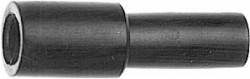
Telegärtner 100001075 strain relief boot black
| Lieske Part No. | 833789 |
|---|---|
| Mfg Part No | 100001075 |
| EAN-Code | 4018359011574 |
| Manufacturer | Telegärtner |
| Here only | 0,55 EUR
0,65 EUR incl. VAT
|
Further information for Telegärtner 100001075 strain relief boot black
| General | |
| Colour | Black |
| Cable groups | G4, G7, G8, G29 |
| Compatible cable types | RG-179B/U, RG-187A/U, 1520A, 1521A, 1522A, 179DT, RG-316/U, KX 22A, KX 3B, RG-174/U, RG-188A/U, MRC 100 Flex, RD-316, G 02232 D, HF 50 0.5/1.5 LDY, K 02252 D, 0.45L/1.4, G 01130 HT-03 |
| Minimum diameter | 2,5 mm |
| Maximum diameter | 3,3 mm |
Applications
The strain relief boot is designed for use in industrial and professional network applications where cables are subjected to high mechanical stress. It is frequently used in the installation of data and communication lines, particularly when cabling network devices, switches, routers, and other IT infrastructure components. The boot is intended for cable groups G4, G7, G8, and G29, which each encompass specific cable types, such as RG-179B/U, RG-316/U, RD-316, or 0.45/1.4. These cable types are used in various application areas, including security technology, monitoring systems, and industrial communication networks.
Functions and Equipment in Detail
The boot is made of a flexible yet durable plastic that provides high mechanical stability. It is black, making it visually inconspicuous in many installations. The shape is cylindrical with a slightly conical transition to ensure a secure and tight fit against the cable jacket. The boot is slipped over the cable and positioned before the cable is inserted into the connector. This reduces mechanical stress at the vulnerable point between the cable jacket and the connector.
Technology Explained Simply
The strain relief function is based on mechanically stabilizing the cable jacket. Repeated bending or stress at the entry point into a socket or connector can cause the jacket to crack or the internal conductors to be damaged. The boot takes on this load and protects the cable from such damage. The boot is designed for cables with an outer diameter between 2.5 mm and 3.3 mm, covering a wide range of standard cables. The material selection ensures sufficient elasticity to securely enclose the cable without damaging it.
Compatibility and Accessories
The strain relief boot is compatible with cables from groups G4, G7, G8, and G29. Group G4 includes cable types such as RG-179B/U, RG-187A/U, and 1520A. Group G7 includes cables such as RG-316/U, RG-174/U, and MRC 100 Flex. Group G8 includes RD-316 and HF 50 0.5/1.5 LDY. Group G29 includes cables such as 0.45L/1.4 and G 01130 HT-03. These cable types are widely used in industrial and professional electrical and IT installations. The boot is typically mounted directly onto the cable without additional tools or adhesives.
Installation and Mounting
Installation is performed by simply sliding the boot onto the cable, positioning it so that it covers the transition area between the cable jacket and the connector. The boot is not glued, screwed, or fixed with tools; it fits securely onto the cable by form-fitting. Installation requires no special tools and can be carried out by skilled personnel without additional aids. The boot is not intended for use in explosive environments or under extreme environmental conditions, as no corresponding approvals or protection ratings are specified.
Operational Advantages
Using the strain relief boot reduces the susceptibility of cables to mechanical damage, especially at vulnerable transition points. This leads to increased operational safety and longer service life of the cabling. The boot is easy to install and requires no additional materials. It is available in black, making it inconspicuous in many installations. The boot is not intended for use in environments with increased fire protection requirements, as no fire protection class or specific flame retardancy is specified.

This is an offer of:
79279 Vörstetten
https://industry-electronics.com
Tel. 07666/88499-0
Fax. 07666/88499-111
Diesen Artikel finden Sie unter:
industry-electronics.com/artikel/833789

Lieske Elektronik e.K.
Reutener Str. 1079279 Vörstetten
https://industry-electronics.com
Tel. 07666/88499-0
Fax. 07666/88499-111
Diesen Artikel finden Sie unter:
industry-electronics.com/artikel/833789