
Synergy 21 S215476 LWL Pigtail LC 50/125 µm OM2 2 m
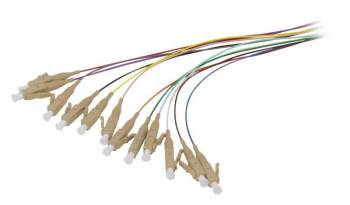
Synergy 21 S215476 LWL Pigtail LC 50/125 µm OM2 2 m
| Lieske Part No. | 1082765 |
|---|---|
| Mfg Part No | S215476 |
| EAN-Code | 4038816064448 |
| Manufacturer | Synergy 21 |
| Here only | 9,18 EUR
10,92 EUR incl. VAT
|
Further information for Synergy 21 S215476 LWL Pigtail LC 50/125 µm OM2 2 m
| Technical data | |
| Connector type | standard |
| Number of fibres/ports | 1(simplex) |
| Side A | LC/UPC (flat polish) |
| Fibre type | OM2_50/125u |
| Length in metres | 2 m |
| Conductor diameter in mm | 0,9 mm |
| Product type | Pigtail |
| Side B | without connector |
Applications
The pigtail is typically used in fiber optic installations where a permanent connection between a patch panel, splice cabinet, or another network device and a fiber optic cable is required. Its intended use is indoors, as it is an indoor cable. The cable color (available in variants Blue, Brown, Yellow, Green, Gray, Orange, Pink, Red, Black, Turquoise, Violet, White) allows for visual identification and organization in complex network installations.
Functions and Equipment in Detail
The cable has a length of 2 meters and a conductor diameter of 0.9 mm. The connector at the end is of LC/UPC type, designed for low insertion loss. The maximum insertion loss is ≤ 0.3 dB at a wavelength of 850 nm, ensuring high signal quality. The fiber is classified as OM2, which stands for multimode connections with a bandwidth of up to 500 MHz·m at 850 nm. The use of LSZH (Low Smoke Zero Halogen) as jacket material ensures low smoke emission and no release of toxic halogens when heated, which is advantageous in enclosed spaces.
Technology Explained Simply
The fiber consists of a gradient profile (gradient fiber), where the refractive index in the core decreases continuously to optimize light guidance. The OM2 classification means the cable is designed for multimode networks with a maximum bandwidth of 500 MHz·m at 850 nm. The LC connector is a standard in fiber optic communication, especially in dense networks, as it is compact and easy to handle. The UPC polish (Ultra Physical Contact) ensures low back reflection, improving signal quality. The cable construction with a loose tube (Loose Tube) protects the fiber from mechanical stress and allows for flexible installation.
Compatibility and Accessories
The pigtail is compatible with standard LWL installations, particularly with LC sockets in patch panels or splice cassettes. It can be combined with accessories such as LWL couplers, splice protection caps, cleaning tools, or fiber splicing equipment. Compatible products include, for example, LWL patch panels for 24xLC duplex sockets, cleaning kits, fiber splicing sets, or tools such as fiber breakers and stripping pliers. The use of appropriate tools and accessories is important to ensure the integrity of the fiber connection.
Installation and Mounting
During installation, a minimum bending radius of 40 mm must be observed to avoid damaging the fiber. Connections should be made exclusively at the connector housing, not on the cable itself, to avoid mechanical stress. Before use, the ferrule of the connector should be protected with a dust cap and cleaned before each use to ensure a clean connection. Installation typically takes place in an enclosed space, such as a server room or a distribution cabinet.
Advantages in Operation
The pigtail provides a reliable and stable connection with low signal loss, which is crucial for network performance. The color marking simplifies identification and maintenance in complex installations. The use of LSZH materials increases safety in enclosed spaces. The standardization of the connector (LC/UPC) ensures broad compatibility with existing infrastructures. The cable construction with a loose tube offers additional protection for the fiber and increases the product's lifespan.
The product is manufactured in China and complies with RoHS 2.0 and REACH standards. Packaging is done in a PE bag with label and test report.

This is an offer of:
79279 Vörstetten
https://industry-electronics.com
Tel. 07666/88499-0
Fax. 07666/88499-111
Diesen Artikel finden Sie unter:
industry-electronics.com/artikel/1082765

Lieske Elektronik e.K.
Reutener Str. 1079279 Vörstetten
https://industry-electronics.com
Tel. 07666/88499-0
Fax. 07666/88499-111
Diesen Artikel finden Sie unter:
industry-electronics.com/artikel/1082765