
Supermicro SYS-821GE-TNHR GPU SuperServer
Computer Hardware > Server > Barebone-Servers
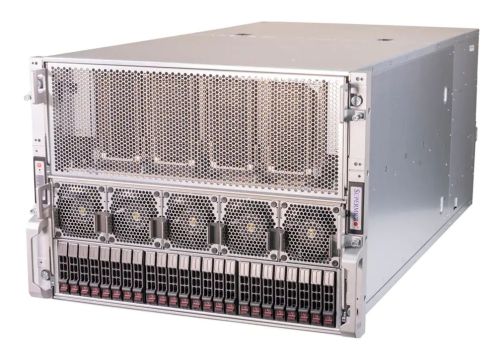
Supermicro SYS-821GE-TNHR GPU SuperServer
| Lieske Part No. | 2517971 |
|---|---|
| Mfg Part No | SYS-821GE-TNHR |
| EAN-Code | |
| Manufacturer | Supermicro |
| Here only | 19.610,96 EUR
23.337,04 EUR incl. VAT
|
Further information for Supermicro SYS-821GE-TNHR GPU SuperServer
| General | |
| CPU socket | 2 (DP) |
| CPU socket type | LGA-4677 |
| DRAM slots | 32 |
| DRAM type | DDR5 |
| Memory bus frequency | 4800 MHz |
| Maximum storage capacity | 8 TB |
| PCIe slots | 8x LP, 2x FHFL Gen 5.0 x16 |
| NVMe Drive Bays | 12 2.5 inch hot-swap |
| M.2 slots | 2 for boot drives |
| SATA drive bays | 8 2.5 inch hot-swap |
| Number of fans | 10 heavy duty |
| Form factor | 8U Rackmount |
| Onboard LAN | IPMI only |
Applications
The server is designed for data center deployment scenarios requiring high computing power, scalability, and reliability. The combination of CPU and GPU enables real-time processing of complex algorithms and large data volumes. Typical use cases include training environments for neural networks, scientific simulations, data analysis, and cloud computing infrastructures relying on GPU-based acceleration.
Features and Equipment in Detail
The system offers 32 DIMM slots for memory, which can be populated with ECC DDR5 RAM. Maximum memory capacity reaches up to 8 TB, with each slot supporting up to 256 GB. The memory bus frequency is 4800 MHz, ensuring high data transfer rates. For storage, 12 hot-swap drive bays for 2.5-inch NVMe drives are provided, supplemented by two M.2 NVMe slots designated exclusively for boot drives. Additionally, eight hot-swap bays for 2.5-inch SATA drives are available, enabling a flexible storage architecture.
Technology Explained Simply
GPU integration via the NVIDIA HGX H100 module with NVLink and NVSwitch technology ensures a direct, high-bandwidth connection between the graphics processors. This reduces latency and enables efficient data distribution, which is particularly advantageous for distributed computing workloads. The PCIe Gen 5.0 interfaces (8x LP and 2x FHFL) offer high I/O performance and support modern peripheral devices. The integrated cooling consists of ten heavy-duty fans with optimized speed control, ensuring efficient heat dissipation while minimizing operational noise.
Compatibility and Accessories
The system is equipped with six redundant power supplies, each with a power rating of 3000 W, configured in a 3+3 setup. Optionally, a 4+4 configuration with eight power supplies is available, providing higher redundancy and load distribution. All power supplies meet the Titanium level, indicating a high efficiency class and energy efficiency. Network connectivity is provided via IPMI (Intelligent Platform Management Interface), enabling remote management and monitoring of the system. No additional network interfaces are integrated into the motherboard.
Mounting and Installation
The server is designed as an 8 U rackmount system, with dimensions of 355.6 mm (height), 437 mm (width), and 843.28 mm (depth). Mounting is performed in standard 19-inch racks. The hot-swap drive bays allow for easy maintenance and replacement without system downtime. Installation requires mounting of processors, memory, and drives, as well as configuration of network settings via IPMI.
Operational Advantages
The combination of dual Intel Xeon processors and eight NVIDIA HGX H100 GPUs provides high computing performance suitable for demanding applications in artificial intelligence and high-performance computing. The redundant power supply with Titanium-level power supplies ensures high availability and energy efficiency. Hot-swap functionality for drives and integrated cooling with intelligent fan management support a maintenance-friendly and reliable operation. IPMI control enables centralized monitoring and remote maintenance of the server.

This is an offer of:
79279 Vörstetten
https://industry-electronics.com
Tel. 07666/88499-0
Fax. 07666/88499-111
Diesen Artikel finden Sie unter:
industry-electronics.com/artikel/2517971

Lieske Elektronik e.K.
Reutener Str. 1079279 Vörstetten
https://industry-electronics.com
Tel. 07666/88499-0
Fax. 07666/88499-111
Diesen Artikel finden Sie unter:
industry-electronics.com/artikel/2517971