
Supermicro SYS-8048B-TR3F SuperServer black
Computer Hardware > Server > Barebone-Servers
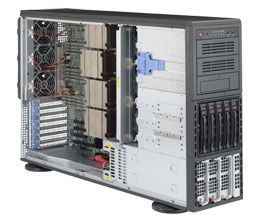
Supermicro SYS-8048B-TR3F SuperServer black
| Lieske Part No. | 2517967 |
|---|---|
| Mfg Part No | SYS-8048B-TR3F |
| EAN-Code | 0672042176908 |
| Manufacturer | Supermicro |
| Here only | 3.259,43 EUR
3.878,72 EUR incl. VAT
|
Further information for Supermicro SYS-8048B-TR3F SuperServer black
| General | |
| Socket type | LGA 2011 |
| Supported processors | Intel Xeon E7-8800 v4/v3, E7-4800 v4/v3 |
| Maximum processor cores | 24 |
| Memory architecture | DDR3 |
| Maximum storage capacity | 2 TB |
| Maximum memory clock frequency | 1600 MHz |
| Number of DIMM Slots | 32 |
| Maximum memory module size | 64 GB LRDIMM |
| PCI-E slots | 2x x16, 2x x8 FH |
| Network card | Intel i350 Dual port GbE LAN |
| Drive bays | 5x 3.5 inch Hot-swap SATA |
| Cooling | 3x 9cm + 3x 8cm heavy duty fans with speed control |
| Current supply | 1400 W Redundant Digital PS |
| Power supply efficiency class | Platinum Level (95%) |
| Form factor | 4U Rackmount/Tower |
Applications
This server is suitable for database applications, virtualization environments, high-availability systems, and other workloads requiring high processor performance and large memory capacities. The 4U form factor enclosure construction allows mounting in standard 19-inch racks, with the option to use it as a tower system also available. The configuration with four processors and high memory capacity makes it particularly suitable for enterprises relying on a central, high-performance server infrastructure.
Features and Equipment in Detail
The system features 32 DIMM slots, supporting a maximum memory capacity of up to 2 TB DDR3 RAM, with individual modules up to 64 GB LRDIMM. The maximum memory clock speed is 1600 MHz. Expandability is ensured by two PCI-E 3.0 x16 and two PCI-E 3.0 x8 full-height slots, which can be used for installing network cards, graphics cards, or storage expansions. The integrated network card is based on the Intel i350 chipset and provides two GbE LAN ports.
Technology Explained Simply
The I/O connections include two GbE LAN ports, a dedicated LAN port for IPMI remote management, a VGA port, a serial COM port, and three USB 2.0 ports. The IPMI function enables remote maintenance and monitoring of the server, even when the operating system status is inactive. Cooling is provided by six high-performance fans – three 9 cm and three 8 cm – with speed control, ensuring efficient and quiet cooling under varying loads. Power supply is provided by a redundant digital power supply with a power rating of 1400 W and a Platinum efficiency class (95 %), ensuring high energy efficiency and reliability in power delivery.
Compatibility and Accessories
The server is designed for use with Intel Xeon E7-8800 v4/v3 and E7-4800 v4/v3 processors. The memory architecture supports DDR3 RAM with a maximum clock speed of 1600 MHz. The five 3.5-inch hot-swap SATA drive bays allow for easy replacement of hard drives without system disassembly. The integrated network card with two GbE ports supports standard network protocols and is suitable for use in local networks. The IPMI function requires a separate IPMI connection, which is implemented via the dedicated LAN port.
Mounting and Installation
The enclosure is in 4U format, with a height of 18.2 inches (462 mm), width of 7.0 inches (178 mm), and depth of 28.4 inches (721 mm). Mounting is done in standard 19-inch racks or as a tower system. The hot-swap drive bays allow for replacement of hard drives without system disassembly. The power supply is redundantly designed, ensuring high availability. Installation requires mounting of processors, memory modules, and drives, as well as cabling of network and I/O connections.
Advantages in Operation
The combination of four processors, high memory capacity, and redundant power supplies ensures high performance and availability. The IPMI function enables remote maintenance, reducing operational costs. The Platinum efficiency class (95 %) reduces power consumption and operational costs. The hot-swap functionality for hard drives and the modular design facilitate maintenance and system expansion.

This is an offer of:
79279 Vörstetten
https://industry-electronics.com
Tel. 07666/88499-0
Fax. 07666/88499-111
Diesen Artikel finden Sie unter:
industry-electronics.com/artikel/2517967

Lieske Elektronik e.K.
Reutener Str. 1079279 Vörstetten
https://industry-electronics.com
Tel. 07666/88499-0
Fax. 07666/88499-111
Diesen Artikel finden Sie unter:
industry-electronics.com/artikel/2517967