
Supermicro SYS-7089P-TR4T SuperServer 7089P-TR4T
Computer Hardware > Server > Barebone-Servers
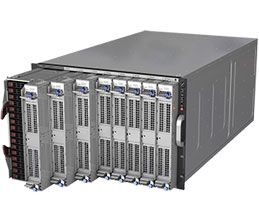
Supermicro SYS-7089P-TR4T SuperServer 7089P-TR4T
| Lieske Part No. | 2517955 |
|---|---|
| Mfg Part No | SYS-7089P-TR4T |
| EAN-Code | |
| Manufacturer | Supermicro |
| Here only | 19.534,99 EUR
23.246,64 EUR incl. VAT
|
Further information for Supermicro SYS-7089P-TR4T SuperServer 7089P-TR4T
| General | |
| Processor socket | LGA 3647 |
| Supported processors | 2nd Gen Intel Xeon Scalable (Cascade Lake/Skylake) |
| Memory Slots | 96 DIMMs |
| Maximum storage capacity | 24 TB |
| Memory type | 3DS ECC DDR4-2933 MHz RDIMM/LRDIMM |
| PCI-E slots | 23 or 39 (OEM) |
| PCI-E generation | 3.0 |
| Network interfaces | 4x 10Gb LAN (SIOM) |
| IPMI management port | 1x dedicated LAN port |
| VGA connector | 1x |
| USB ports | 2x USB 2.0 |
| COM port | 1x via KVM |
| Drive bays | 16x Hot-swap 2.5" SAS3 |
| Internal drive bays | 8x 2.5" or 6x 3.5" |
| Cooling | 8x 9cm Hot-swap counter-rotating rear fans |
| Current supply | 5x 1600W (N+2) redundant |
| Power supply efficiency class | Titanium Level (96%) |
| Form factor | 7U Rackmountable |
| Weight total | 94.35 kg |
| Optane DCPMM support | |
Applications
This server is suitable for enterprises prioritising high availability, scalability, and performance. Typical use cases include cloud infrastructures, big data analytics, virtual desktop infrastructures (VDI), and high-performance computing (HPC). Support for up to 24 TB of memory in the form of 3DS ECC DDR4-2933 MHz RDIMM/LRDIMM enables processing of large data volumes. Integration of Intel Optane DCPMM extends the memory hierarchy and supports low-latency access to large datasets.
Features and Specifications in Detail
The system offers 96 DIMM slots, enabling a maximum memory capacity of 24 TB. Memory modules are equipped with 3DS ECC technology, ensuring high data integrity and fault tolerance. Support for DDR4-2933 MHz RDIMM/LRDIMM provides sufficient bandwidth for demanding applications. The platform includes 23 or 39 PCI-E 3.0 slots (depending on OEM configuration), which can be flexibly utilised for various requirements. Possible configurations include up to eight full-height high-performance PCI-E cards (e.g. GPUs), 16 U.2 NVMe SSDs, or a combination of memory and network cards. The PCIe slots are available in various form factors, including FH x16, FHFL x16, and LP x8 (in x16), enabling integration of different components.
Technology Explained Simply
PCIe 3.0 technology offers high data transfer rates and is suitable for modern storage and network modules. Support for U.2 NVMe SSDs enables fast, parallel access to storage, which is critical for I/O-intensive applications. Integrated network connectivity includes four 10 GbE LAN ports (SIOM), a dedicated LAN port for IPMI remote management, a VGA port, two USB 2.0 ports, and a COM port via KVM. These interfaces allow flexible integration into existing network infrastructures and efficient remote maintenance of the system.
Compatibility and Accessories
The server is compatible with a RAID controller, enabling use of the 16 hot-swap 2.5-inch SAS3 drive bays. Additionally, 8x 2.5-inch or 6x 3.5-inch internal drive bays are available, also with RAID support. Cooling is provided by eight 9-cm hot-swap counter-rotating fans located at the rear, ensuring efficient airflow and heat dissipation. Power supply is handled by five redundant power units with a capacity of 1600 W in N+2 redundancy mode, featuring Titanium-level efficiency (96%). This configuration ensures high availability and energy efficiency.
Mounting and Installation
The server is designed in 7U rack format and can be mounted in standard 19-inch racks. Dimensions are 310 mm (height), 448 mm (width), and 733 mm (depth). Mounting is achieved via integrated rails, enabling secure fixation in the rack. Hot-swap drives and redundant power supplies facilitate maintenance and component replacement without system downtime.
Operational Advantages
The combination of high processor count, large memory capacity, and flexible PCIe infrastructure makes this server a powerful platform for demanding IT environments. Redundant power supply and hot-swap features increase system availability. The IPMI remote management function enables remote maintenance, reducing operational costs. Titanium-level efficiency of the power supplies reduces energy consumption and operating costs during continuous operation.

This is an offer of:
79279 Vörstetten
https://industry-electronics.com
Tel. 07666/88499-0
Fax. 07666/88499-111
Diesen Artikel finden Sie unter:
industry-electronics.com/artikel/2517955

Lieske Elektronik e.K.
Reutener Str. 1079279 Vörstetten
https://industry-electronics.com
Tel. 07666/88499-0
Fax. 07666/88499-111
Diesen Artikel finden Sie unter:
industry-electronics.com/artikel/2517955