
Supermicro SYS-7049GP-TRT SuperWorkstation
Computer Hardware > Server > Barebone-Servers
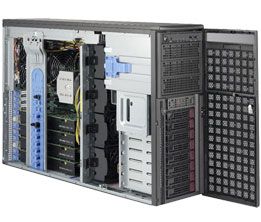
Supermicro SYS-7049GP-TRT SuperWorkstation
| Lieske Part No. | 2517952 |
|---|---|
| Mfg Part No | SYS-7049GP-TRT |
| EAN-Code | 0672042291427 |
| Manufacturer | Supermicro |
| Here only | 2.846,86 EUR
3.387,76 EUR incl. VAT
|
Further information for Supermicro SYS-7049GP-TRT SuperWorkstation
| General | |
| CPU socket | 2 (DP) |
| CPU socket type | LGA-3647 |
| DRAM slots | 16 |
| DRAM type | DDR4 |
| Form factor | 4U Rackmountable / Tower |
| Power supplies | 2 |
| Onboard LAN | 10Gbit/s |
| Server type | Workstation |
| PCIe slots | 4 x16 (double-width), 2 x16 (single-width), 1 x4 (in x8) |
| Drive bay | 8 Hot-swap 3.5" |
| LAN ports | 2x 10GBase-T |
| Interfaces | VGA, 2 COM, 5 USB 3.0 |
| Cooling | 4 heavy duty fans, 4 exhaust fans, 2 active heatsink |
| Current supply | 2200W redundant, Titanium Level (96%) |
| GPU kit | MCP-320-74702-0N-KIT |
| Memory support | up to 4TB 3DS ECC DDR4-2933MHz RDIMM/LRDIMM |
| Processor type | 2nd Gen. Intel Xeon Scalable (Cascade Lake/Skylake) |
| Onboard graphics | |
Applications
This server is suitable for scenarios requiring high computing power and simultaneous scalability, for example in data centers, research institutions, or companies with high data processing requirements. The combination of dual-socket support, large memory capacity, and multiple PCIe slots makes it particularly suitable for applications with high I/O and memory demands. The 8 hot-swap 3.5-inch drive bays enable a flexible and service-friendly configuration with hard drives or SSDs.
Functions and Features in Detail
The SYS-7049GP-TRT offers 16 DIMM slots for DDR4-2933MHz RDIMM or LRDIMM modules, enabling a maximum memory capacity of up to 4 TB. Support for Intel Optane DCPMM extends the memory architecture with persistent memory solutions, ensuring fast data access and improved system responsiveness. The integrated graphics solution allows direct screen connection to the server, enabling local operation and diagnostics.
Technology Explained Simply
The platform features a total of five PCIe 3.0 slots: four in double-width format (x16), two in single-width format (x16), and one additional slot in x4 format (physically x8). This configuration provides sufficient connectivity options for additional graphics cards, network cards, or storage controllers. Network functionality is provided via two 10GBase-T LAN ports using an Intel X5501 chipset, ensuring high bandwidth for data exchange. Interfaces also include a VGA port, two serial COM ports, and five USB 3.0 ports, enabling flexible peripheral connectivity.
Compatibility and Accessories
The server is equipped with a GPU kit (MCP-320-74702-0N-KIT), enabling the installation of passive graphics processors or coprocessors. This expands application possibilities, particularly for compute-intensive tasks such as machine learning or scientific simulations. Compatibility with second-generation Intel Xeon Scalable processors and support for DDR4-2933MHz memory modules ensure high performance and scalability.
Mounting and Installation
The device is designed in 4U format and can be mounted in standard racks or operated as a tower system. Dimensions are 462 mm in height, 178 mm in width, and 673 mm in depth. Cooling is provided by four heavy-duty fans, four exhaust fans, and two active heatsinks, all equipped with optimal fan speed control to minimize thermal load. Power supply is provided by two redundant power units with a capacity of 2200W, achieving Titanium level (96% efficiency).
Operational Advantages
The redundant power supply and robust cooling ensure high system availability and reliability. The hot-swap functionality of the drives allows for service-friendly expansion and replacement without system shutdown. The integrated graphics and extensive interfaces simplify system configuration and maintenance. Support for Intel Optane DCPMM extends the memory architecture and improves system performance in memory-intensive applications.

This is an offer of:
79279 Vörstetten
https://industry-electronics.com
Tel. 07666/88499-0
Fax. 07666/88499-111
Diesen Artikel finden Sie unter:
industry-electronics.com/artikel/2517952

Lieske Elektronik e.K.
Reutener Str. 1079279 Vörstetten
https://industry-electronics.com
Tel. 07666/88499-0
Fax. 07666/88499-111
Diesen Artikel finden Sie unter:
industry-electronics.com/artikel/2517952