
Supermicro SYS-7039A-I SuperWorkstation 7039A-i
Computer Hardware > Server > Barebone-Servers
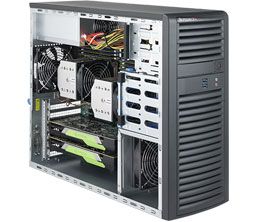
Supermicro SYS-7039A-I SuperWorkstation 7039A-i
| Lieske Part No. | 2517944 |
|---|---|
| Mfg Part No | SYS-7039A-I |
| EAN-Code | |
| Manufacturer | Supermicro |
| Here only | 1.146,08 EUR
1.363,84 EUR incl. VAT
|
Further information for Supermicro SYS-7039A-I SuperWorkstation 7039A-i
| General | |
| Socket type | LGA 3647 |
| Processor type | 2nd Gen Intel Xeon Scalable (Cascade Lake/Skylake) |
| Memory card slots | 16 DIMMs |
| Maximum memory | 4 TB |
| Memory type | 3DS ECC DDR4-2933 MHz RDIMM/LRDIMM |
| PCIe slots | 4 x16, 2 x8 PCI-E 3.0 |
| M.2 interface | PCI-E 3.0 x4 |
| M.2 form factors | 2260, 2280, 22110 |
| M.2 key | M-Key |
| NVMe ports | 2 internal |
| Network connections | 2x 1GbE LAN |
| Audio function | 7.1 HD Audio |
| Drive bays | 4x 3.5" fixed, 2x 5.25" peripheral |
| Power supply unit power | 1200 W |
| Power supply efficiency | Platinum Level Certified |
| Form factor | Mid-Tower |
| Optane DCPMM support | |
Applications
The server is suitable for application scenarios in professional data processing, such as in data centers, for virtual machines, database applications, or as a basis for high-performance computing (HPC). The support for Intel Optane DCPMM expands the application possibilities in applications with high memory requirements, particularly for workloads that rely on fast, persistent memory.
Features and Equipment in Detail
The SYS-7039A-I offers 16 DIMM slots, supporting up to 4 TB of system memory in the form of 3DS ECC DDR4-2933 MHz RDIMM or LRDIMM. The memory technology enables high reliability and error correction, which is important for critical applications. The integrated support for Intel Optane DCPMM allows the use of persistent memory, which functions as fast, non-volatile system memory. The platform features four PCIe 3.0 x16 slots and two PCIe 3.0 x8 slots, enabling flexible expansion with graphics cards, network cards, or storage modules.
Technology Explained Simply
The M.2 interface supports the PCI-E 3.0 x4 standard and is designed for M-Key modules. The supported form factors include 2260, 2280, and 22110, enabling a wide range of SSD modules. Two internal NVMe ports are available, with the use of two NVMe modules optionally requiring additional cables. The integrated network card provides two 1 GbE LAN ports, ensuring a stable network connection. The integrated 7.1 HD Audio technology is intended for applications with high audio requirements, although it is often not used in server environments.
Compatibility and Accessories
The server is equipped with a 1200 W high-efficiency power supply that meets the Platinum Level Certification of the 80 PLUS standard. This guarantees high efficiency and energy efficiency. The internal storage architecture includes four fixed 3.5-inch drive bays and two 5.25-inch peripheral bays, which can be used for hard drives, optical drives, or other units. The M.2 interface supports the mentioned form factors and enables installation of SSDs with M-Key connectors.
Mounting and Installation
The server is designed in mid-tower format, with dimensions height 424 mm, width 193 mm, and depth 525.3 mm. Mounting is possible in standard 19-inch racks or as a freestanding unit. Installation requires mounting the processors, memory, and storage media, as well as connecting internal cables. The network card and audio function connectors are already integrated.
Advantages in Operation
The combination of dual-socket support, high memory capacity, and multiple PCIe slots offers high scalability. The energy efficiency of the power supply reduces power consumption and operating costs. Support for Intel Optane DCPMM enables improved performance in memory-intensive applications. The integrated network and audio functions reduce the need for additional cards, thereby lowering system complexity.

This is an offer of:
79279 Vörstetten
https://industry-electronics.com
Tel. 07666/88499-0
Fax. 07666/88499-111
Diesen Artikel finden Sie unter:
industry-electronics.com/artikel/2517944

Lieske Elektronik e.K.
Reutener Str. 1079279 Vörstetten
https://industry-electronics.com
Tel. 07666/88499-0
Fax. 07666/88499-111
Diesen Artikel finden Sie unter:
industry-electronics.com/artikel/2517944