
Supermicro SYS-621BT-HNTR BigTwin SuperServer
Computer Hardware > Server > Barebone-Servers
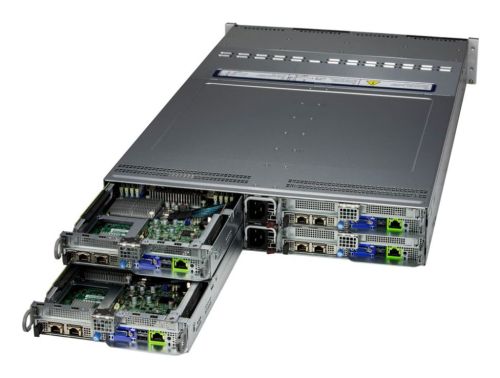
Supermicro SYS-621BT-HNTR BigTwin SuperServer
| Lieske Part No. | 2517929 |
|---|---|
| Mfg Part No | SYS-621BT-HNTR |
| EAN-Code | |
| Manufacturer | Supermicro |
| Here only | 8.922,53 EUR
10.617,81 EUR incl. VAT
|
Further information for Supermicro SYS-621BT-HNTR BigTwin SuperServer
| General | |
| Form factor | 2U Rackmount |
| CPU socket | LGA |
| CPU count | 2 (DP) |
| Processor type | 5th/4th Gen Intel Xeon Scalable |
| Chipset | Intel C741 |
| DRAM slots | 16 |
| DRAM type | ECC DDR5 |
| PCIe slots | 2 x PCIe 5.0 x16 (LP) |
| M.2 NVMe support | 2 x over internal PCIe 4.0 x8 |
| M.2 Boot Controller | optional via SCC-A2NMG3-B1 |
| Network | AIOM (OCP 3.0 compliant) |
| Onboard LAN | IPMI only |
| Drive bay | 3 hot-swap 3,5 Zoll |
| Drive interfaces | 2x PCIe 5.0 NVMe/SATA, 1x PCIe 4.0 NVMe/SATA |
| Cooling | 4 fans, 14.9K RPM, Shared Cooling Design |
| Power supplies | 2 redundant |
| Power supply efficiency | Titanium Level (96%+) |
| Power supply design | Shared Power Design |
Applications
The server is suitable for applications in high availability, cloud computing, virtualisation, and big data. The four independent nodes allow for flexible resource allocation and maintenance without taking the entire system offline. The hot-plug capability of the nodes enables individual systems to be replaced during operation, which is advantageous for critical infrastructures. The integrated support for Liquid Cooling offers additional options for heat dissipation under heavy loads.
Features and equipment in detail
Each node features two PCIe 5.0 x16 (LP) slots, suitable for high-performance graphics or network cards. An internal PCIe 4.0 x8 bus enables the connection of two M.2 NVMe SSDs directly to the motherboard. Optionally, an M.2 NVMe Boot Controller can be added via the SCC-A2NMG3-B1 module to support booting from M.2 drives. Memory expansion is achieved through the 16 DIMM slots per node, which support ECC DDR5 RAM, ensuring error correction and system stability.
Technology explained simply
The platform uses a Shared Cooling Design with four fans per 2U housing, ensuring even cooling of the four nodes. The fans operate at a speed of 14,900 RPM, enabling efficient heat dissipation under heavy load. The redundant power supplies achieve the Titanium efficiency class (96%+) and are integrated in a Shared Power Design, meaning power supply for all nodes comes from a common power supply system. This increases energy efficiency and reduces power supply complexity. Network connectivity is provided via AIOM (Active Interface Optical Module), which is OCP 3.0-compatible, enabling flexible and scalable network connectivity.
Compatibility and accessories
The platform is designed for Intel Xeon Scalable processors of the 4th and 5th generation. Support for PCIe 5.0 and 4.0 allows the use of modern storage and network modules. The three hot-swap 3.5-inch drive bays provide space for hard drives or SSDs; two bays support PCIe 5.0 NVMe/SATA, the third supports PCIe 4.0 NVMe/SATA. The integrated IPMI network interface enables remote maintenance and monitoring of the server.
Mounting and installation
The server is designed for 2U rack mounting and fits into standard 19-inch racks. Dimensions are 88 mm in height, 449 mm in width, and 774 mm in depth. Mounting is done using standard rack rails. The hot-plug capability of the nodes allows for easy maintenance and replacement without system crash. Tool-less installation of components (e.g. memory modules) simplifies assembly and maintenance.
Advantages in operation
The combination of four independent nodes in a 2U housing maximises hardware density. The hot-plug function and redundant power supply increase availability. Support for Liquid Cooling and the high efficiency of the power supplies (Titanium level) reduce energy consumption and operating costs. The integrated IPMI function enables remote management, simplifying maintenance in distributed environments. The platform is designed for use in modern data centres with high demands on performance, scalability, and reliability.

This is an offer of:
79279 Vörstetten
https://industry-electronics.com
Tel. 07666/88499-0
Fax. 07666/88499-111
Diesen Artikel finden Sie unter:
industry-electronics.com/artikel/2517929

Lieske Elektronik e.K.
Reutener Str. 1079279 Vörstetten
https://industry-electronics.com
Tel. 07666/88499-0
Fax. 07666/88499-111
Diesen Artikel finden Sie unter:
industry-electronics.com/artikel/2517929