
Supermicro SYS-620TP-HC0TR Twin SuperServer 620TP-HC0TR
Computer Hardware > Server > Barebone-Servers
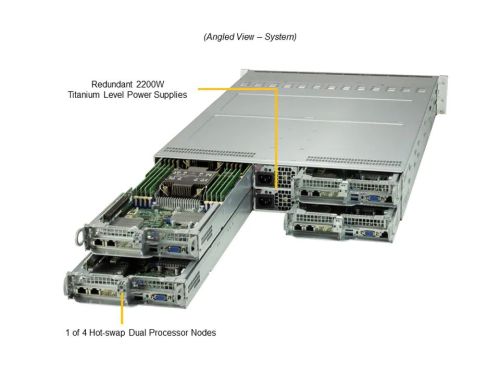
Supermicro SYS-620TP-HC0TR Twin SuperServer 620TP-HC0TR
| Lieske Part No. | 2517924 |
|---|---|
| Mfg Part No | SYS-620TP-HC0TR |
| EAN-Code | |
| Manufacturer | Supermicro |
| Here only | 7.343,89 EUR
8.739,23 EUR incl. VAT
|
Further information for Supermicro SYS-620TP-HC0TR Twin SuperServer 620TP-HC0TR
| General | |
| Form factor | 2U Rackmount |
| Processor socket | LGA-4189 |
| Processor type | 3rd Generation Intel Xeon Scalable |
| Chipset | Intel C621A |
| Memory card slots | 16 DIMMs |
| Maximum memory | 4 TB |
| Memory type | 3DS ECC DDR4-3200 LRDIMM/RDIMM |
| PCIe slots | 2x x16 LP, 1x x8 |
| PCIe generation | 4.0 |
| Network controller | Intel X710 |
| Network connection | Dual port 10GBase-T LAN |
| SAS controller | Broadcom 3008 |
| SAS speed | 12 Gbps |
| RAID support | 0, 1, 1E, 10 |
| Number of SATA drive bays | 3 3.5 inch |
| Number of NVMe slots | 2 via M.2 adapter |
| Number of fans | 4 8 cm PWM per system |
| Current supply | 2x 2200W redundant |
| Power supply control | PMBus |
| BMC | ASPEED AST2600 |
| BMC connectors | 2 USB, VGA, RoT, 2 SATADOM |
Applications
The server is designed for use cases requiring multiple independent computing instances in a compact rack format, such as in cloud infrastructures, virtualization environments, or high-availability solutions. The hot-pluggable design allows maintenance work without interrupting the operation of other nodes, making it particularly suitable for critical applications. The integrated RAID functionality and support for SATA and NVMe storage media also make it suitable for database and storage applications.
Functions and Equipment in Detail
Each node supports Dual-Socket P+ (LGA-4189) processors from the 3rd generation Intel Xeon Scalable family, ensuring high computing performance and energy efficiency. The platform is based on the Intel C621A chipset and offers 16 DIMM slots per node, enabling a maximum memory capacity of up to 4 TB using 3DS ECC DDR4-3200 LRDIMM/RDIMM memory modules. The memory architecture ensures high bandwidth and reliability for demanding workloads.
Technology Explained Simply
The integrated Intel X710 network card provides two 10GBase-T ports, enabling high network bandwidth for data exchange within the data center. The PCIe slots (2x PCIe 4.0 x16 LP, 1x PCIe 4.0 x8) support installation of expansion cards, with the x8 slot supporting up to two NVMe SSDs in 22x80 mm format when using an M.2 adapter. Cooling is provided by four robust 8 cm PWM fans per system, enabling optimal fan speed control to stabilize operating temperature and optimize energy consumption.
Compatibility and Accessories
The platform is equipped with a Broadcom 3008 SAS controller (12 Gbps), providing three SAS slots per node and supporting RAID levels 0, 1, 1E, and 10. This enables flexible configurations for storage redundancy and performance optimization. The integrated ASPEED AST2600 BMC (Baseboard Management Controller) offers remote maintenance functions via IPMI, including two USB ports, VGA connection, RoT (Read-Only Trusted), and two SATADOM ports, which can be used for storing operating systems or firmware images.
Mounting and Installation
The server is designed as a 2U rack-mount unit, with dimensions of 89 mm (height), 438 mm (width), and 774 mm (depth). Installation is performed in standard 19-inch racks, with the four nodes being independently installed and maintained. The two 2200W redundant power supplies with PMBus interface ensure reliable power supply and enable load sharing as well as monitoring of power parameters.
Operational Advantages
The modular architecture with four independent nodes offers high flexibility in resource allocation and maintenance. The hot-pluggable design reduces downtime, as individual nodes can be maintained or replaced without affecting the operation of the others. The integrated BMC function enables remote monitoring and control, improving operational efficiency in large infrastructures. Support for modern storage and networking technologies ensures high performance and scalability.

This is an offer of:
79279 Vörstetten
https://industry-electronics.com
Tel. 07666/88499-0
Fax. 07666/88499-111
Diesen Artikel finden Sie unter:
industry-electronics.com/artikel/2517924

Lieske Elektronik e.K.
Reutener Str. 1079279 Vörstetten
https://industry-electronics.com
Tel. 07666/88499-0
Fax. 07666/88499-111
Diesen Artikel finden Sie unter:
industry-electronics.com/artikel/2517924