
Supermicro SYS-620P-TR SuperServer
Computer Hardware > Server > Barebone-Servers
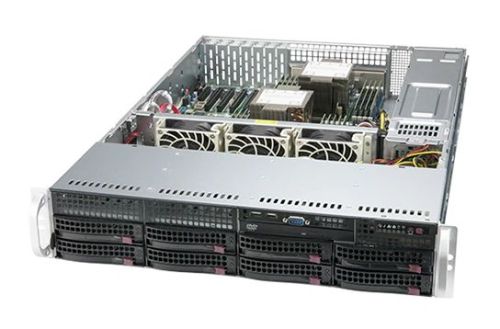
Supermicro SYS-620P-TR SuperServer
| Lieske Part No. | 2517922 |
|---|---|
| Mfg Part No | SYS-620P-TR |
| EAN-Code | 0672042423569 |
| Manufacturer | Supermicro |
| Here only | 1.979,78 EUR
2.355,94 EUR incl. VAT
|
Further information for Supermicro SYS-620P-TR SuperServer
| General | |
| Processor type | 3rd Gen Intel® Xeon® Scalable |
| Socket | LGA-4189 |
| CPU TDP | 270 W |
| Chipset | Intel® C621A |
| DIMM slots | 18 |
| Memory type | ECC LRDIMM/RDIMM DDR4 |
| Memory frequency | 3200 MHz |
| Maximum storage capacity | 4 TB |
| Persistent Memory | Intel® Optane™ 200 Series |
| PCI-E expansion slots | 6 |
| LAN ports | 2 1 Gbit/s |
| Drive bay | 8 3.5 in SATA |
| M.2 slot | 1 NVMe |
| Fans | 3 heavy duty |
| Power supply power | 1200 W |
| Power supply efficiency | Titanium Level |
| VGA connector | 1 |
| COM ports | 2 |
| USB 2.0 ports | 2 front |
| USB 3.0 ports | 4 rear |
| Form factor | 2U Rackmount |
| IPMI | |
Applications
The server is designed for use cases requiring high computing performance, large memory capacities, and high availability, such as virtualization, database applications, cloud computing, big data processing, or as a foundation for high-performance computing. Support for up to 4 TB of memory, combining DRAM and Intel® Optane™ persistent memory 200 Series, allows for flexible memory configurations for different workloads. The 8x 3.5-inch SATA drive bays provide sufficient space for hard drives or SSDs, with an additional M.2 NVMe slot available for fast, supplementary storage media.
Features and Equipment in Detail
The system includes 18 DIMM slots, compatible with ECC LRDIMM/RDIMM DDR4 memory modules in 3200 MHz format. This memory type ensures high reliability through error correction (ECC) and is suitable for critical server applications. Support for Intel® Optane™ persistent memory extends memory options with non-volatile memory, which can function as fast, durable working memory. For expansion, six PCI-E slots are available, enabling integration of graphics cards, network adapters, or storage controllers.
Technology Explained Simply
Network connectivity is provided via two 1 Gbit/s LAN ports, suitable for redundant network connections. The integrated IPMI function (Intelligent Platform Management Interface) enables remote management and monitoring of the server, even when powered off. Power supply is provided by redundant AC power units with a capacity of 1200 W, meeting the Titanium-level efficiency standard. These power units are controllable via PMBUS 1.2, allowing precise load regulation and monitoring of the power supply. Cooling is ensured by three robust fans with optimal speed control, adjusting cooling performance according to load conditions.
Compatibility and Accessories
The server is equipped with a comprehensive I/O panel: one VGA port, two serial COM ports, two USB 2.0 ports (front), and four USB 3.0 ports (rear) offer diverse connectivity options. The combination of SATA drive bays, M.2 slot, and PCI-E slots enables flexible expansion with various storage and network modules. Compatibility with 3rd generation Intel® Xeon® Scalable processors and the C621A chipset ensures the system works with current server technologies.
Mounting and Installation
The 2U rackmount design with dimensions 89 mm (height), 437 mm (width), and 647 mm (depth) allows easy installation in standard 19-inch racks. The pre-assembled mounting structure and redundant power supply facilitate integration into existing infrastructures. The weight specification of 31.2 kg (69 lbs) should be considered for transportation and installation.
Operational Advantages
The combination of high processor performance, large memory capacity, redundant power supplies, and integrated remote maintenance function (IPMI) ensures high availability and maintainability. Support for persistent memory expands memory options and enables more efficient use of working memory in applications requiring fast, durable storage. The Titanium-level efficiency of the power units reduces energy consumption and lowers operating costs.

This is an offer of:
79279 Vörstetten
https://industry-electronics.com
Tel. 07666/88499-0
Fax. 07666/88499-111
Diesen Artikel finden Sie unter:
industry-electronics.com/artikel/2517922

Lieske Elektronik e.K.
Reutener Str. 1079279 Vörstetten
https://industry-electronics.com
Tel. 07666/88499-0
Fax. 07666/88499-111
Diesen Artikel finden Sie unter:
industry-electronics.com/artikel/2517922