
Supermicro SYS-6028U-E1CNR4T+ SuperServer 6028U-E1CNR4T+
Computer Hardware > Server > Barebone-Servers
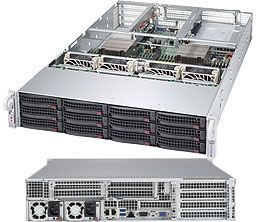
Supermicro SYS-6028U-E1CNR4T+ SuperServer 6028U-E1CNR4T+
| Lieske Part No. | 2517849 |
|---|---|
| Mfg Part No | SYS-6028U-E1CNR4T |
| EAN-Code | 0672042184781 |
| Manufacturer | Supermicro |
| Here only | 2.610,41 EUR
3.106,39 EUR incl. VAT
|
Further information for Supermicro SYS-6028U-E1CNR4T+ SuperServer 6028U-E1CNR4T+
| General | |
| Socket type | LGA 2011 |
| Processor type | Intel Xeon E5-2600v4/v3 |
| QPI bandwidth | 9,6 GT/s |
| Maximum storage capacity | 3 TB |
| Memory type | ECC 3DS LRDIMM |
| Memory bus frequency | 2400 MHz |
| DIMM slots | 24 |
| PCI-Express slots | 6 x8 |
| PCI-Express generation | 3.0 |
| Network connections | 4 10GBase-T |
| Hard drive bays | 12 Hot-swap 3.5-inch |
| NVMe ports | 4 |
| SAS3 ports | 12 via Expander and AOC |
| Number of fans | 4 heavy duty |
| Fan control | optimal fan speed control |
| Current supply | Redundant |
| Efficiency class | Titanium Level |
| Efficiency | 96 % |
Applications
This server is suitable for applications in high-performance computing, virtualisation, databases, storage solutions, and network services. Support for up to 3 TB ECC 3DS LRDIMM memory with a maximum clock speed of DDR4- 2400 MHz enables efficient handling of large data volumes. The 24 DIMM slots provide sufficient capacity for scaling memory. The high memory capacity and speed are particularly relevant for applications requiring fast access to large data sets, such as in cloud infrastructure or big data analytics.
Features and Specifications in Detail
The server includes six PCI-Express 3.0 x8 slots, four of which are in full-height format (10.5L), and one each in low-profile format (LP) and internal LP format. This configuration allows installation of various expansion cards, such as network adapters, graphics cards, or storage controllers. The four integrated 10GBase-T network ports offer high bandwidth for network data traffic and are suitable for connection to modern switches and network infrastructures.
Technical Explanation
The 12 hot-swap 3.5-inch drive bays allow for easy and quick replacement of drives without shutting down the system. This is especially important in high-availability environments where service interruptions must be avoided. Drives can be connected via SAS3 or NVMe technology. The NVMe ports provide direct connection to NVMe drives, while the SAS3 ports can be expanded using expander and AOC adapters (AOC-S3108L-H8iR-16DD, AOC-S3108L-H8iR, AOC-S3008L-L8e, AOC-S3008L-L8i). This enables flexible configuration of the storage architecture according to requirements.
Compatibility and Accessories
The server is equipped with four heavy-duty fans that allow for optimal fan speed control. This ensures efficient cooling while simultaneously reducing operating noise. The redundant power supply at Titanium level offers an efficiency class of up to 96 % and ensures reliable power supply. The power supply is designed for high efficiency and reliability in critical environments. The mentioned AOC adapters (AOC-S3108L-H8iR-16DD, AOC-S3108L-H8iR, AOC-S3008L-L8e, AOC-S3008L-L8i) are intended for expanding storage and network functions and can be combined as needed.
Mounting and Installation
The server is designed as a rack system and can be mounted in standard 19-inch racks. Mounting is done via designated mounting points and screws. The hot-swap drive bays are designed for easy installation and maintenance. Expansion cards are inserted into the PCI-Express slots, with placement varying according to card format and requirements. The network ports are designed for direct connection to network cables.
Operational Advantages
The Supermicro SuperServer 6028U-E1CNR4T+ offers high scalability through numerous DIMM slots and expansion options. The redundant power supply and hot-swap functions increase system availability. The high efficiency of the power supply reduces energy consumption and operating costs. Support for modern processors and memory technologies enables long-term use and adaptation to future requirements. The integrated network ports and expansion options via AOC adapters provide flexibility in network and storage architecture.

This is an offer of:
79279 Vörstetten
https://industry-electronics.com
Tel. 07666/88499-0
Fax. 07666/88499-111
Diesen Artikel finden Sie unter:
industry-electronics.com/artikel/2517849

Lieske Elektronik e.K.
Reutener Str. 1079279 Vörstetten
https://industry-electronics.com
Tel. 07666/88499-0
Fax. 07666/88499-111
Diesen Artikel finden Sie unter:
industry-electronics.com/artikel/2517849