
Supermicro SYS-6028TP-HC0R SuperServer black
Computer Hardware > Server > Barebone-Servers
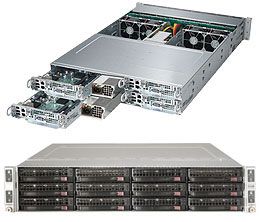
Supermicro SYS-6028TP-HC0R SuperServer black
| Lieske Part No. | 2517839 |
|---|---|
| Mfg Part No | SYS-6028TP-HC0R |
| EAN-Code | 0672042160686 |
| Manufacturer | Supermicro |
| Here only | 4.470,96 EUR
5.320,44 EUR incl. VAT
|
Further information for Supermicro SYS-6028TP-HC0R SuperServer black
| General | |
| Form factor | 2U Rackmount |
| Processor socket | LGA 2011 |
| Supported processors | Intel Xeon E5-2600v4/ v3 |
| QPI speed | 9,6 GT/s |
| Memory capacity per node | 2 TB |
| Memory type | ECC 3DS LRDIMM |
| Memory clock rate | 2400 MHz |
| DIMM slots per node | 16 |
| PCI-E slots | 1x x16 Low-profile, 1x x16 (0 Slot) |
| Network interface | Intel i350-AM2 Dual port GbE LAN |
| IPMI version | 2.0 |
| Hard drive bays | 3x 3.5 inch hot-swap |
| SAS controller | LSI 3008 SAS3 |
| SAS controller ports | 8 |
| Supported RAID levels | 0, 1, 10 |
| Current supply | Redundant |
| Power supply efficiency | 96% |
| Weight total | 40,9 kg |
| Mini-mSATA support | |
Applications
This server is suitable for applications in high-availability, cloud computing, virtualisation, and data processing. The four independent nodes enable a modular infrastructure that can adapt to different load profiles. The integrated IPMI 2.0 function with KVM support and a dedicated LAN port allows remote maintenance and monitoring of systems, even in case of failure, which is crucial for critical IT environments. Its use in data centres with high demands on energy efficiency and maintainability is particularly well-suited due to redundant power supply and hot-swap features.
Functions and Equipment in Detail
Each node features 16 DIMM slots supporting up to 2 TB ECC 3DS LRDIMM memory with a maximum clock rate of DDR4- 2400 MHz. This memory configuration enables high bandwidth and reliability, especially for demanding workloads. The integrated Intel i350-AM2 dual-port GbE LAN interface provides redundant network connectivity and supports standard network protocols. Additionally, there is one PCI-E 3.0 x16 low-profile slot and another x16 slot (0 slot) to install expansion cards such as network adapters, storage controllers, or GPUs.
Technology Explained Simply
The LSI 3008 SAS3 controller technology with eight ports enables connection to up to eight SAS or SATA hard drives. Support for RAID levels 0, 1, and 10 offers flexibility in configuring storage arrays, with RAID 1 and 10 providing higher data security. The three 3.5-inch hot-swap drive bays allow drives to be replaced without shutting down the system. Mini-mSATA (half-size) support enables installation of small, fast SSDs for boot or cache purposes. The redundant power supply with Titanium-level efficiency (96%) ensures reliable power delivery and minimises energy consumption.
Compatibility and Accessories
The server is compatible with Intel Xeon E5-2600v4 and E5-2600v3 series processors. The memory configuration supports ECC 3DS LRDIMMs, which are required in server environments to ensure data integrity. The network interface is based on the Intel i350-AM2 controller, offering standard network functions. The IPMI 2.0 integration enables remote control and monitoring via a dedicated LAN port. The hot-swap drive bays are designed for 3.5-inch drives, with LSI SAS3 controllers enabling connection to SAS and SATA drives.
Mounting and Installation
The system is designed as a 2U rack-mount housing with dimensions of 438 mm (width), 88 mm (height), and 774 mm (depth). Mounting is performed in standard 19-inch racks. The hot-swap features and redundant power supply simplify installation and maintenance, as individual components can be replaced without shutting down the entire system. The integrated IPMI control enables remote maintenance, reducing the need for physical presence on-site.
Operational Advantages
The modular architecture with four independent nodes offers high flexibility in resource allocation. Hot-swap features and redundant power supply increase system availability. High memory capacity and ECC memory support ensure stable and error-free data processing. IPMI 2.0 integration enables efficient remote maintenance, reducing operational costs. The Titanium-level efficiency of the power supply reduces energy consumption and contributes to sustainability.

This is an offer of:
79279 Vörstetten
https://industry-electronics.com
Tel. 07666/88499-0
Fax. 07666/88499-111
Diesen Artikel finden Sie unter:
industry-electronics.com/artikel/2517839

Lieske Elektronik e.K.
Reutener Str. 1079279 Vörstetten
https://industry-electronics.com
Tel. 07666/88499-0
Fax. 07666/88499-111
Diesen Artikel finden Sie unter:
industry-electronics.com/artikel/2517839