
Supermicro SYS-6028R-TRT SuperServer black
Computer Hardware > Server > Barebone-Servers
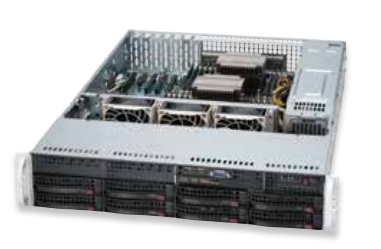
Supermicro SYS-6028R-TRT SuperServer black
| Lieske Part No. | 2517832 |
|---|---|
| Mfg Part No | SYS-6028R-TRT |
| EAN-Code | 0672042151905 |
| Manufacturer | Supermicro |
| Here only | 1.489,18 EUR
1.772,12 EUR incl. VAT
|
Further information for Supermicro SYS-6028R-TRT SuperServer black
| General | |
| Socket | LGA 2011 |
| Processor type | Intel Xeon E5-2600v4/ v3 |
| QPI | 9,6 GT/s |
| Memory | up to 2 TB |
| Memory type | ECC 3DS LRDIMM |
| Memory clock frequency | DDR4- 2400 MHz |
| DIMM slots | 16 |
| PCI-E slots | 3x x16, 3x x8 |
| Network card | Intel X540 Dual port 10GBase-T |
| SATA controller | Intel C612 |
| SATA ports | 8 |
| RAID support | 0, 1, 5, 10 |
| Hard disk bays | 8 3.5-inch Hot-swap |
| Current supply | 740W redundant |
| Efficiency class | Platinum |
| Form factor | 2U Rackmount |
Applications
The server is designed for use in professional IT infrastructures, particularly in environments requiring high computing performance, scalability, and reliability. The 8 hot-swap bays for 3.5-inch SATA3 hard drives enable flexible and maintenance-friendly storage expansion. The integrated RAID functionality (levels 0, 1, 5, 10) via the Intel C612 controller provides additional data security and performance optimisation. Support for up to 2 TB ECC 3DS LRDIMM memory with a maximum clock frequency of DDR4- 2400 MHz ensures sufficient memory for performance-intensive applications.
Features and Equipment in Detail
The system features 16 DIMM slots, enabling installation of up to 2 TB ECC 3DS LRDIMM memory. The memory modules are compatible with DDR4- 2400 MHz clock frequency, offering a balanced combination of speed and energy efficiency. The integrated Intel X540 network card provides two 10GBase-T ports, ensuring high network bandwidth in modern data centres. The PCI-Express slots include three x16 and three x8 slots in PCI-E 3.0 standard, allowing installation of additional network, storage, or graphics cards.
Technology Explained Simply
The use of ECC memory (Error-Correcting Code) ensures higher data security, as memory errors can be detected and corrected. The 3DS-LRDIMM technology (3D Stacked Load-Reduced DIMM) enables higher memory density and reduces load on memory buses, improving stability at high memory capacities. The hot-swap function for hard drives allows drives to be replaced without system restart, increasing availability. The redundant power supply with 740 W power output and Platinum efficiency class (94 % efficiency) ensures reliable power supply and minimises energy consumption.
Compatibility and Accessories
The server is compatible with Intel Xeon E5-2600v4 and E5-2600v3 processors. The integrated Intel C612 controller technology supports up to eight SATA3 ports and enables RAID configurations. The Intel X540 network card provides dual-port 10GBase-T connections, suitable for fast network connections. The PCI-E 3.0 slots allow expansion with additional components adapted to the respective specifications.
Mounting and Installation
The server is designed in 2U rack-mount format, with a width of 437 mm, height of 89 mm, and depth of 648 mm. Mounting is performed in standard 19-inch racks. The hot-swap hard drive modules can be replaced without tools, simplifying maintenance. The redundant power supply ensures continuous operational safety, even in case of failure of one power source.
Operational Advantages
The combination of dual-socket design, high memory capacity, RAID support, and 10GBase-T network connection makes the server a powerful solution for enterprise applications. The Platinum efficiency class of the power supply reduces energy consumption, while the hot-swap function and redundant power supply increase operational reliability. The expandability via PCI-E slots allows adaptation to future requirements.

This is an offer of:
79279 Vörstetten
https://industry-electronics.com
Tel. 07666/88499-0
Fax. 07666/88499-111
Diesen Artikel finden Sie unter:
industry-electronics.com/artikel/2517832

Lieske Elektronik e.K.
Reutener Str. 1079279 Vörstetten
https://industry-electronics.com
Tel. 07666/88499-0
Fax. 07666/88499-111
Diesen Artikel finden Sie unter:
industry-electronics.com/artikel/2517832