
Supermicro SYS-6018TR-TF SuperServer
Computer Hardware > Server > Barebone-Servers
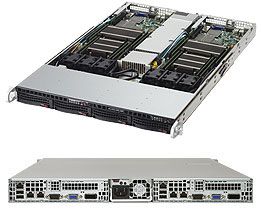
Supermicro SYS-6018TR-TF SuperServer
| Lieske Part No. | 2517804 |
|---|---|
| Mfg Part No | SYS-6018TR-TF |
| EAN-Code | 0672042183517 |
| Manufacturer | Supermicro |
| Here only | 2.736,91 EUR
3.256,92 EUR incl. VAT
|
Further information for Supermicro SYS-6018TR-TF SuperServer
| General | |
| Form factor | 1U rackmount |
| Socket | LGA 2011 |
| Processor type | Intel Xeon E5-2600v4/ v3 |
| QPI | 9,6 GT/s |
| Memory | up to 1 TB |
| Type of memory | ECC 3DS LRDIMM |
| Memory bus | DDR4- 2400 MHz |
| DIMM slots | 8 |
| PCIe slots | 1x PCI-E 3.0 x16 (in x16) |
| Drive bay | 2x 3.5 inch hot-swap |
| Drive interface | SAS/SATA |
| InfiniBand | Single port FDR 56 Gbps |
| InfiniBand connector | QSFP |
| LAN controller | Intel i350 Dual port GbE |
| I/O ports | 2x SuperDOM, 1x VGA, 1x COM, 2x USB 2.0 (rear) |
| Current supply | 1000 W |
| Efficiency class | Titanium Level Certified |
Applications
This server is suitable for applications requiring high processor performance and simultaneous resource utilization in a compact rack format. These include high-availability environments, virtualization environments, database servers, and applications in the field of cloud computing infrastructure. The dual node integration in a 1U housing enables efficient use of rack space, particularly in environments where multiple independent systems are needed but space is limited.
Features and Equipment in Detail
Each node provides eight DIMM slots supporting up to 1 TB ECC 3DS LRDIMM memory. The maximum memory bandwidth is DDR4- 2400 MHz, ensuring sufficient performance for demanding applications. The memory architecture with LRDIMMs allows higher memory capacity per slot and is suitable for server environments with high memory requirements. The integrated graphics and I/O infrastructure includes two SuperDOM connectors, one VGA connector, one serial COM port, and two USB 2.0 ports at the rear, which can be used for system maintenance and configuration.
Technology Explained Simply
The platform offers a PCIe 3.0 x16 slot (in x16), which can be used for installing expansion cards such as network adapters, graphics cards, or storage controllers. The integrated network functionality includes a single-port InfiniBand (FDR, 56 Gbps) with QSFP connector, suitable for high-speed connections in data centers. Additionally, an Intel i350 dual-port GbE LAN controller is integrated, enabling standard network connections via Gigabit Ethernet. Power supply is provided by a 1000 W efficient power supply unit, which meets the Titanium Level certification, ensuring high energy efficiency and low operating costs.
Compatibility and Accessories
The server is designed for use with Intel Xeon E5-2600v4 and E5-2600v3 processors, connected via the LGA 2011 socket. Memory support includes ECC 3DS LRDIMMs with a maximum clock frequency of DDR4- 2400 MHz. The two 3.5-inch hot-swap drive bays allow installation of SAS or SATA hard drives, with the hot-swap feature enabling drive replacement without system shutdown. The integrated InfiniBand and Gigabit Ethernet connections allow integration into existing network environments.
Mounting and Installation
The housing is in 1U rack format, with a width of 437 mm, height of 44.45 mm, and depth of 705 mm. Mounting is done in standard 19-inch racks, with pre-defined mounting holes and compact design enabling easy installation. The weight is specified as 19.5 kg (43 lbs), which should be considered during mounting and transport planning.
Operational Advantages
The combination of two independent nodes in a 1U housing enables high resource utilization and flexibility in system architecture. The hot-swap feature of the drives reduces downtime, while the Titanium certification of the power supply leads to lower operating costs. Support for ECC memory increases system stability and prevents memory errors that could lead to data loss or system crashes. The integrated network options (InfiniBand and Gigabit Ethernet) offer flexibility in network integration, with the InfiniBand connection being particularly suitable for high-performance applications.

This is an offer of:
79279 Vörstetten
https://industry-electronics.com
Tel. 07666/88499-0
Fax. 07666/88499-111
Diesen Artikel finden Sie unter:
industry-electronics.com/artikel/2517804

Lieske Elektronik e.K.
Reutener Str. 1079279 Vörstetten
https://industry-electronics.com
Tel. 07666/88499-0
Fax. 07666/88499-111
Diesen Artikel finden Sie unter:
industry-electronics.com/artikel/2517804