
Supermicro SYS-6018R-WTR SuperServer
Computer Hardware > Server > Barebone-Servers
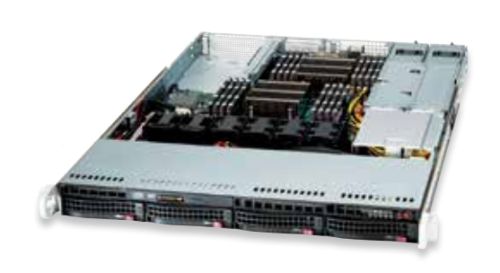
Supermicro SYS-6018R-WTR SuperServer
| Lieske Part No. | 2517801 |
|---|---|
| Mfg Part No | SYS-6018R-WTR |
| EAN-Code | 0672042157518 |
| Manufacturer | Supermicro |
| Here only | 1.338,22 EUR
1.592,48 EUR incl. VAT
|
Further information for Supermicro SYS-6018R-WTR SuperServer
| General | |
| Socket | LGA 2011 |
| Supported processors | Intel Xeon E5-2600v4/ v3 |
| QPI | 9,6 GT/s |
| Memory type | ECC 3DS LRDIMM |
| Memory bus | DDR4- 2400 MHz |
| DIMM slots | 16 |
| PCI-Express slots | 2x x16 FHHL |
| Network card | Intel i350 Dual port GbE LAN |
| Hard drive bays | 4x 3.5" Hot-swap SAS/SATA |
| I/O ports | 2x SuperDOM, 1x VGA, 1x Serial, 6x USB 3.0 (4 rear) |
| Current supply | 700W Redundant |
| Efficiency class | Platinum Level |
| Form factor | 1U rackmount |
| Height | 43 mm |
Applications
The server is suitable for applications in data processing, virtualisation, cloud infrastructure, and high-performance computing. The 1U form factor allows dense installation in standard 19-inch racks, minimising space requirements. Support for up to 2 TB ECC 3DS LRDIMM memory with a maximum clock speed of DDR4- 2400 MHz and 16 DIMM slots provides sufficient capacity for demanding workloads. The memory architecture ensures high bandwidth and reliability, particularly for critical applications requiring error correction (ECC) and high memory densities.
Features and Equipment in Detail
The system includes two PCI-Express 3.0 x16 slots in Full-Height-Full-Length format (FHHL), enabling installation of Add-on Controller modules (AOC). These expand I/O functionality, for example for additional network or storage controllers. The integrated network card is based on the Intel i350 chipset and provides two Gigabit Ethernet ports, sufficient for standard network connections. The I/O ports include two SuperDOM connectors, one VGA port, one serial port, and six USB 3.0 ports (four at the rear), enabling flexible peripheral connectivity.
Technology Explained Simply
The memory architecture with 16 DIMM slots and support for DDR4- 2400 MHz enables high memory bandwidth, important for performance-intensive applications. The use of ECC 3DS LRDIMMs ensures high data integrity and allows utilisation of large memory amounts without performance loss. The 700-Watt redundant power supplies (RPS) at Platinum efficiency level ensure reliable power supply and minimise energy consumption. Redundancy means that if one power supply fails, the other automatically takes over to prevent server downtime.
Compatibility and Accessories
The server is designed for use with 3.5-inch hot-swap SAS/SATA hard drives, with four drive bays available. This configuration allows flexible storage adaptation to specific requirements, whether for high capacity or high access speed. The hot-swap function allows drives to be replaced without system restart, which is advantageous for maintenance and operation in production environments. The integrated network card supports Gigabit Ethernet, with higher bandwidths achievable by installing external network controllers via the PCI-Express slots.
Mounting and Installation
The server is designed as a 1U rack-mount system and fits into standard 19-inch racks. Dimensions are 437 mm width, 43 mm height, and 650 mm depth. Mounting is done via integrated mounting holes and screws designed for rack installation. The weight is 20.9 kg (46 lbs), which should be considered when planning rack load.
Operational Advantages
The combination of Dual-Socket platform, high memory capacity, redundant power supplies, and hot-swap drives makes the server a robust solution for critical applications. High energy efficiency at Platinum level reduces operating costs, while power supply redundancy increases availability. Integrated I/O ports and support for AOC modules offer flexibility in adapting to specific requirements.

This is an offer of:
79279 Vörstetten
https://industry-electronics.com
Tel. 07666/88499-0
Fax. 07666/88499-111
Diesen Artikel finden Sie unter:
industry-electronics.com/artikel/2517801

Lieske Elektronik e.K.
Reutener Str. 1079279 Vörstetten
https://industry-electronics.com
Tel. 07666/88499-0
Fax. 07666/88499-111
Diesen Artikel finden Sie unter:
industry-electronics.com/artikel/2517801