
Supermicro SYS-5019D-FN8TP SuperServer
Computer Hardware > Server > Barebone-Servers
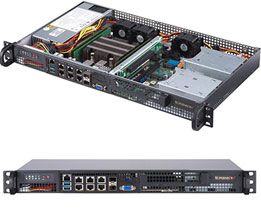
Supermicro SYS-5019D-FN8TP SuperServer
| Lieske Part No. | 2517699 |
|---|---|
| Mfg Part No | SYS-5019D-FN8TP |
| EAN-Code | |
| Manufacturer | Supermicro |
| Here only | 1.604,73 EUR
1.909,63 EUR incl. VAT
|
Further information for Supermicro SYS-5019D-FN8TP SuperServer
| General | |
| Form factor | 1U rackmount |
| Processor | Intel Xeon D-2146NT |
| Cores | 8 |
| Threads | 16 |
| Clock frequency | 2666 MHz |
| Max. power consumption | 80 W |
| Memory card slots | 4 |
| Memory type | DDR4 |
| Max. RAM (LRDIMM) | 512 GB |
| Max. RAM (RDIMM) | 256 GB |
| Graphics | onboard |
| VGA connector | 1 |
| USB 3.0 | 2 |
| Network connections | 4x 1GbE, 2x 10GBase-T, 2x 10G SFP+ |
| IPMI port | 1 |
| M.2 slots | 2 |
| Mini-PCI-E slot | 1 |
| PCI-E 3.0 x8 slot | 1 |
| Fans | 3 |
| Power adaptor | 200 W |
| Cooling | 40x28 mm, 4-PIN PWM |
| QAT technology | up to 40 Gbps |
| Storage bays | 2x 3.5 inch or 4x 2.5 inch |
Applications
This server is particularly suitable for virtualisation applications, where multiple network services are executed on a common hardware platform. It is ideal for edge computing environments, where data is processed close to the point of origin to minimise latency. The integrated support for IoT gateway functions enables the connection and control of networked devices in industrial or connected environments. The combination of high network bandwidth and integrated security features also makes it suitable for applications in network security and data compression.
Functions and equipment in detail
The server features four DIMM slots, which can be populated with DDR4-2666Mz RAM. The maximum memory capacity is 512 GB when using ECC LRDIMM modules or 256 GB when using ECC/non-ECC RDIMM modules. The integrated graphics function enables screen output via a VGA connection, facilitating local system maintenance and diagnostics. Two USB 3.0 ports offer high-speed data transfer rates for external devices.
Technology explained simply
The platform offers a flexible memory architecture with two internal 3.5-inch or four internal 2.5-inch drive bays. An M.2 slot in M-Key format supports SSDs with a maximum bandwidth of 2242/8, while another M.2 slot in B-Key format is designed for SSDs or WAN cards. A Mini-PCI-E slot with mSATA support and a PCI-E 3.0 x8 slot extend connectivity options for additional components. The integrated Intel QAT technology (QuickAssist Technology) supports cryptographic operations and data compression up to 40 Gbps, increasing efficiency in security-critical applications.
Compatibility and accessories
The server is equipped with extensive network connectivity: four 1GbE ports, two 10GBase-T ports, two 10G SFP+ ports, and a dedicated LAN port for IPMI 2.0. This configuration enables flexible connection to various network environments, from local networks to high-speed connections. The IPMI 2.0 interface allows remote maintenance and monitoring of the system, even when powered off. The integrated graphics function and USB ports support local system configuration and diagnostics.
Mounting and installation
The server is designed in a 1U rack format, with a height of 1.7 inches (43 mm), a width of 17.2 inches (437 mm), and a depth of 9.8 inches (249 mm). Installation is carried out in standard 19-inch racks. Cooling is provided by three 40x28 mm 4-PIN PWM fans, ensuring quiet and efficient cooling. The integrated 200-W power supply is designed for low noise emission and supports the operating voltage of the server.
Advantages in operation
The server offers high performance density in a compact form factor, making it particularly suitable for racks with limited space. The integrated QAT technology reduces CPU load during cryptographic and compression tasks, enhancing system efficiency. Support for multiple network standards and IPMI 2.0 functionality enables flexible and reliable network integration as well as remote maintenance. The combination of integrated graphics, USB ports, and multiple storage options provides flexibility in system configuration and maintenance.

This is an offer of:
79279 Vörstetten
https://industry-electronics.com
Tel. 07666/88499-0
Fax. 07666/88499-111
Diesen Artikel finden Sie unter:
industry-electronics.com/artikel/2517699

Lieske Elektronik e.K.
Reutener Str. 1079279 Vörstetten
https://industry-electronics.com
Tel. 07666/88499-0
Fax. 07666/88499-111
Diesen Artikel finden Sie unter:
industry-electronics.com/artikel/2517699