
Supermicro SYS-5019A-FN5T SuperServer
Computer Hardware > Server > Barebone-Servers
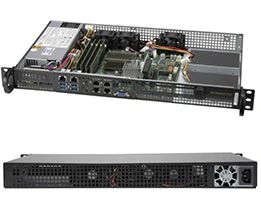
Supermicro SYS-5019A-FN5T SuperServer
| Lieske Part No. | 2517694 |
|---|---|
| Mfg Part No | SYS-5019A-FN5T |
| EAN-Code | |
| Manufacturer | Supermicro |
| Here only | 1.327,12 EUR
1.579,27 EUR incl. VAT
|
Further information for Supermicro SYS-5019A-FN5T SuperServer
| General | |
| Processor | Intel® Atom® C3958 16-Core, TDP 31W |
| Socket | FCBGA 1310 Single-Socket |
| Memory card slots | 4 DIMM slots |
| Maximum memory | 256 GB ECC RDIMM DDR42400 MHz |
| Max. memory UDIMM | 64 GB ECC/non-ECC |
| Network connections | 4x 10GbE LAN, 1x 1GbE LAN (IPMI shared LAN) |
| PCI-E slots | 1x x8, 1x M-Key, 1x B-Key PCI-E 3.0 |
| USB ports | 4 front Type-A, USB 3.0 |
| Connections | 1 VGA, 1 SuperDOM |
| Cooling | 3x 40x28mm 4-pin PWM fans |
| Current supply | 200W Low-noise AC-DC |
| Technology | Intel® Quick Assist Technology |
| Form factor | 1U rackmount |
| Storage bays | 1x 3.5 Zoll oder 2x 2.5 Zoll |
Applications
This server is suitable for applications requiring high network capacity with minimal space requirements, such as network and storage solutions, virtualisation environments with low resource demands, or as a base for IoT and edge computing systems. The integrated support for Intel® Quick Assist Technology (QAT) enables accelerated encryption and data compression, which is particularly beneficial for security-critical or data-intensive applications. The 1U form factor makes it ideal for use in standard 19-inch racks.
Features and Specifications in Detail
The SYS-5019A-FN5T features four DIMM slots that can be populated with up to 256 GB ECC RDIMM DDR42400 MHz or 64 GB ECC/non-ECC UDIMM. This memory configuration offers flexibility in choosing between high capacity and lower cost, depending on requirements. The integrated memory controller supports the required memory module types and speeds to ensure system stability and performance. For data storage, internal bays are available: either one 3.5-inch drive or two 2.5-inch drives, enabling flexible adaptation to different storage needs.
Technology Explained Simply
The system is equipped with four 10-Gigabit Ethernet ports, providing high network bandwidth for data transfer and server communication. Additionally, a 1-Gigabit Ethernet port is included for IPMI management (Intelligent Platform Management Interface), enabling remote server maintenance. The network connections are implemented via PCI-E 3.0 x8 and x2 slots, with the x2 slots also supporting SATA and USB functions. The PCIe slots allow installation of additional expansion cards, with M-Key and B-Key slots suitable for various applications. Power supply is provided by a 200-Watt AC-DC power supply unit, designed for quiet operation and reliable power delivery to system components.
Compatibility and Accessories
The server includes a TPM module (Trusted Platform Module) for secure authentication and encryption of system data. Additionally, four USB 3.0 ports (Type A) are integrated on the front panel, along with a VGA port and a SuperDOM (Super Disk On Module) for system boot capability without external storage. Cooling is provided by three 40x28 mm 4-pin PWM fans, ensuring efficient and quiet system cooling. The integrated Intel® Quick Assist Technology supports acceleration of encryption and compression tasks, which is particularly advantageous for network applications with high data rates.
Mounting and Installation
The server is designed as a 1U rackmount system and fits into standard 19-inch racks. Dimensions are 1.7 inches (43 mm) in height, 17.2 inches (437 mm) in width, and 9.8 inches (249 mm) in depth. Mounting is done via integrated rack rails, with no additional mounting accessories required. Installation of internal components, such as memory modules or drives, is performed using standardised holders and sockets, enabling easy maintenance and expansion.
Operational Advantages
The server is characterised by low energy consumption and quiet operation, making it particularly suitable for environments where noise and power costs are important. The integrated IPMI function enables remote maintenance and monitoring of the system, increasing uptime and reducing maintenance intervals. Support for ECC memory enhances system stability and prevents memory errors, which is especially important in critical applications. The combination of high network bandwidth and compact form factor makes the server an efficient solution for various IT infrastructures.

This is an offer of:
79279 Vörstetten
https://industry-electronics.com
Tel. 07666/88499-0
Fax. 07666/88499-111
Diesen Artikel finden Sie unter:
industry-electronics.com/artikel/2517694

Lieske Elektronik e.K.
Reutener Str. 1079279 Vörstetten
https://industry-electronics.com
Tel. 07666/88499-0
Fax. 07666/88499-111
Diesen Artikel finden Sie unter:
industry-electronics.com/artikel/2517694