
Supermicro SYS-5018R-M SuperServer black
Computer Hardware > Server > Barebone-Servers
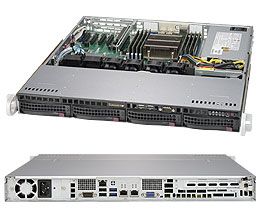
Supermicro SYS-5018R-M SuperServer black
| Lieske Part No. | 2517690 |
|---|---|
| Mfg Part No | SYS-5018R-M |
| EAN-Code | |
| Manufacturer | Supermicro |
| Here only | 773,14 EUR
920,04 EUR incl. VAT
|
Further information for Supermicro SYS-5018R-M SuperServer black
| General | |
| Processor socket | LGA 2011 |
| Supported processors | Intel Xeon E5-2600v4/ v3 |
| QPI connection | up to 9.6 GT/s |
| Chipset | Intel C612 |
| Drive bays | 4x 3.5 inch Hot-Swap SATA3 |
| Memory card slots | 8x DIMM |
| Maximum storage capacity | 1 TB |
| Memory type | ECC 3DS LRDIMM |
| Memory frequency | up to DDR4-2400 MHz |
| PCI-E slots | 1x PCI-E 3.0 x16 |
| Network card | Intel i350-AM2 Dual port GbE LAN |
| IPMI | IPMI 2.0 with KVM and dedicated LAN |
| I/O connections | 1x VGA, 1x COM, 2x USB 3.0, 4x USB 2.0 |
| Form factor | 1U rackmount |
Applications
This server is suitable for applications in data processing, virtualisation, network and storage infrastructures. The 1U form factor enables dense installation in standard 19-inch racks, making it ideal for small to medium data centres or edge computing environments. Support for Intel Xeon processors makes it particularly suitable for applications with high computational demands, such as databases, web servers or virtualisation platforms.
Functions and Equipment in Detail
The system offers four 3.5-inch hot-swap SATA3 drive bays, enabling flexible and redundant storage expansion. Drives can be replaced during operation, increasing system availability. The memory architecture includes eight DIMM slots, compatible with ECC 3DS LRDIMMs. Maximum memory capacity is 1 TB, with supported memory frequencies up to DDR4-2400 MHz. This ensures high bandwidth and reliability for critical applications.
Technology Explained Simply
The integrated Intel i350-AM2 network card provides two Gigabit Ethernet ports, designed for high-availability and high-performance network connections. Support for IPMI 2.0 (Intelligent Platform Management Interface) enables remote server management, including remote KVM functions. This is particularly useful for maintenance and diagnostics of systems that are not physically accessible. The dedicated LAN port for IPMI ensures that management functions remain available independently of the main network.
Compatibility and Accessories
The server features one PCI-E 3.0 x16 slot, suitable for installing graphics cards, network adapters or storage expansion cards. I/O interfaces include a VGA port, a serial COM port, two USB 3.0 and four USB 2.0 ports, enabling flexible connection of peripheral devices. The power supply is an 80 PLUS Gold Level module, offering high efficiency and energy savings. The power supply is designed for operation in 230 V networks, common in Europe and many other regions.
Mounting and Installation
The server is designed as a 1U rack-mount system, with dimensions of 43 mm (height), 437 mm (width) and 503 mm (depth). Mounting is performed in standard 19-inch racks using integrated mounting brackets. The weight is 13.8 kg, which should be considered when planning rack load. Installation requires mounting of processors, memory and drives, as well as cabling of network and I/O interfaces.
Operational Advantages
The combination of Intel Xeon processors, high memory capacity and redundant storage bays enables high performance and availability. Remote management via IPMI 2.0 reduces maintenance effort, especially for distributed systems. The energy efficiency of the 80 PLUS Gold Level power supply reduces operational energy consumption. The hot-swap function for drives allows maintenance without system downtime. The platform is modular, enabling adaptation to different requirements without altering the basic system structure.

This is an offer of:
79279 Vörstetten
https://industry-electronics.com
Tel. 07666/88499-0
Fax. 07666/88499-111
Diesen Artikel finden Sie unter:
industry-electronics.com/artikel/2517690

Lieske Elektronik e.K.
Reutener Str. 1079279 Vörstetten
https://industry-electronics.com
Tel. 07666/88499-0
Fax. 07666/88499-111
Diesen Artikel finden Sie unter:
industry-electronics.com/artikel/2517690