
Supermicro SYS-5018D-LN4T SuperServer
Computer Hardware > Server > Barebone-Servers
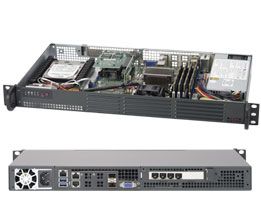
Supermicro SYS-5018D-LN4T SuperServer
| Lieske Part No. | 2517689 |
|---|---|
| Mfg Part No | SYS-5018D-LN4T |
| EAN-Code | |
| Manufacturer | Supermicro |
| Here only | 625,30 EUR
744,11 EUR incl. VAT
|
Further information for Supermicro SYS-5018D-LN4T SuperServer
| General | |
| Processor | Intel Pentium D1508 |
| Processor socket | FCBGA 1667 |
| Cores | 2 |
| Threads | 4 |
| TDP | 25 W |
| System architecture | Intel System-on-Chip design |
| Memory card slots | 4 |
| Max. memory capacity (ECC RDIMM) | 128 GB |
| Max. memory capacity (UDIMM) | 64 GB |
| Type of memory | ECC RDIMM DDR4 1866 MHz or ECC/non-ECC UDIMM |
| Hard drives | 1x 3,5 Zoll oder bis zu 4x 2,5 Zoll |
| PCI-E slot | 1x PCI-E 3.0 x8 |
| M.2 interface | M.2 PCIe 3.0 x4, M Key 2242/2280/22110 |
| Network connections | Dual 10G SFP+ and Dual 1GbE LAN |
| Current supply | 200W Low-noise with PFC |
| Form factor | 1U rackmount |
Applications
The server is suitable for tasks requiring a stable, compact, and energy-efficient platform, such as network and storage solutions, small database applications, virtualisation, or security solutions. The combination of integrated networking and sufficient storage expandability makes it an appropriate base for single-server or edge computing applications. The 1U form factor design enables dense installation in standard racks.
Features and Equipment in Detail
The server features a flexible memory architecture with up to four DIMM sockets, supporting up to 128 GB ECC RDIMM DDR41866 MHz or 64 GB ECC/non-ECC UDIMM. Memory options allow adaptation to different requirements for error correction and capacity. For data storage, the system offers either a 3.5 in hard drive bay or up to four 2.5 in hard drive bays, enabling flexible configuration depending on the application. Integrated network connectivity includes two 10G SFP+ and two 1GbE LAN ports, suitable for redundant or high-bandwidth network connections.
Technology Explained Simply
The processor with 25W TDP is designed for continuous operation and reduces energy consumption compared to more powerful models. The Intel System-on-Chip design integrates key functions such as network and storage control into the processor, simplifying the system architecture and reducing the number of required chips. Support for M.2 PCIe 3.0 x4 (M Key 2242/2280/22110) as well as Mini-PCIe with mSATA support expands storage and interface options. The integrated 200W low-noise power supply with PFC (Power Factor Correction) ensures efficient and quiet power delivery, suitable for use in server rooms.
Compatibility and Accessories
The server is equipped with a PCI-E 3.0 x8 slot, enabling installation of expansion cards such as graphics cards, network adapters, or storage controllers. The M.2 and Mini-PCIe interfaces allow integration of SSDs or other modules connected via M-Key connectors. The network ports support standard and high-speed connections, with SFP+ ports suitable for optical or copper cables. Compatibility with ECC RDIMM and UDIMM modules offers flexibility in memory selection.
Mounting and Installation
The server is designed for mounting in standard 19 in racks. Mounting is done via integrated rack mounting points, allowing secure fixation in the rack. The dimensions conform to the 1U standard, so it can be placed in standard server racks without additional modifications. Power supply is via a DOM connector, which connects to the rack power supply.
Operational Advantages
The server offers a compact form factor with high functionality. Integrated network connectivity and support for ECC memory increase reliability. The quiet power supply and low TDP of the processor reduce operational noise and cooling requirements. Flexible memory and expansion options allow adaptation to different requirements without replacing the entire platform.

This is an offer of:
79279 Vörstetten
https://industry-electronics.com
Tel. 07666/88499-0
Fax. 07666/88499-111
Diesen Artikel finden Sie unter:
industry-electronics.com/artikel/2517689

Lieske Elektronik e.K.
Reutener Str. 1079279 Vörstetten
https://industry-electronics.com
Tel. 07666/88499-0
Fax. 07666/88499-111
Diesen Artikel finden Sie unter:
industry-electronics.com/artikel/2517689