
Supermicro SYS-220TP-HC8TR Twin SuperServer 220TP-HC8TR
Computer Hardware > Server > Barebone-Servers
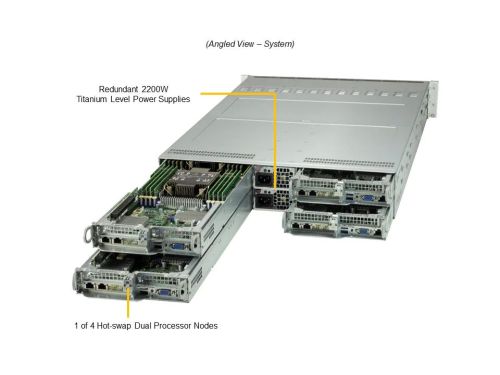
Supermicro SYS-220TP-HC8TR Twin SuperServer 220TP-HC8TR
| Lieske Part No. | 2517632 |
|---|---|
| Mfg Part No | SYS-220TP-HC8TR |
| EAN-Code | |
| Manufacturer | Supermicro |
| Here only | 7.104,13 EUR
8.453,91 EUR incl. VAT
|
Further information for Supermicro SYS-220TP-HC8TR Twin SuperServer 220TP-HC8TR
| General | |
| Form factor | 2U Rackmount |
| Number of nodes | 4 |
| Processor socket | Dual Socket P+ (LGA-4189) |
| Processor generation | 3rd Generation Intel Xeon Scalable |
| Chipset | Intel C621A |
| Memory card slots | 16 DIMMs |
| Maximum storage capacity | 4 TB |
| Memory type | 3DS ECC DDR4-3200 LRDIMM/RDIMM |
| PCI-E slots | 1 x16 (LP), 1 x8 (with M.2 adapter) |
| NVMe support | up to 2 NVMe-SSDs (22x80 mm) |
| Network | Intel X710 Dual-Port 10GBase-T LAN |
| Drive bays | 6 x 2.5 inch hot-swap SATA/SAS |
| Cooling | 4 x 8 cm PWM fans per system |
| Current supply | 2 x 2200W redundant with PMBus |
| BMC | ASPEED AST2600 |
| BMC Interfaces | 2 USB, VGA |
| SAS controller | Broadcom 3808 SAS (12Gbps) |
Applications
This server is designed for use in professional IT environments where high availability, scalability, and energy efficiency are required. The four independent Nodes allow for modular expansion and maintenance without taking the entire system offline. Support for Dual Socket P+ (LGA-4189) enables installation of 3rd Generation Intel Xeon Scalable processors, making the platform suitable for demanding workloads such as databases, virtualization, or high-performance computing.
Features and Specifications in Detail
Each Node features an Intel C621A chipset and supports up to 16 DIMMs with a maximum memory capacity of 4 TB using 3DS ECC DDR4-3200 LRDIMM/RDIMM modules. The memory architecture ensures high bandwidth and reliability, which is essential for critical applications. The integrated Intel X710 Dual-Port 10GBase-T LAN card provides fast network connectivity with support for 10 Gigabit Ethernet over copper cables. For storage expansion, six 2.5-inch hot-swap SATA/SAS drive bays are available per Node, enabling easy replacement without system downtime.
Technology Explained Simply
The platform uses PCI-E 4.0 interfaces, with one slot offering x16 bus width and another offering x8 bus width (when a M.2 adapter is installed). This allows for up to two NVMe SSDs in 22x80 mm format per Node. The Broadcom 3808 SAS (12Gbps) controllers offer high data transfer rates and are configured as HBA (Host Bus Adapter), meaning no integrated RAID functionality is available. Cooling is provided by four robust 8 cm PWM fans per system, supporting optimal fan speed control to minimize energy consumption and noise.
Compatibility and Accessories
The server is equipped with an ASPEED AST2600 BMC, featuring a serial interface, two USB ports, and a VGA connector. This enables remote maintenance and monitoring of the system via IPMI (Intelligent Platform Management Interface). Power supply is provided by two 2200W redundant power supplies with PMBus, ensuring high efficiency and reliability. The redundant power supply protects against failures caused by a defective power unit.
Mounting and Installation
The housing has a height of 3.5 inches (89 mm), a width of 17.25 inches (438 mm), and a depth of 28.75 inches (730 mm). It is designed for installation in standard 19-inch racks. Mounting is achieved via integrated rails, ensuring secure fixation in the rack. The total weight of the system is 90 lbs (40.9 kg).
Operational Advantages
The modular design with four independent Nodes enables flexible usage and maintenance. Hot-swap functionality for drives and redundant power supply increase system availability. Support for modern processors and memory modules ensures high computational performance, while the integrated network card and SAS controllers ensure fast data transfer. Remote management via BMC simplifies system monitoring and control, especially in distributed infrastructures.

This is an offer of:
79279 Vörstetten
https://industry-electronics.com
Tel. 07666/88499-0
Fax. 07666/88499-111
Diesen Artikel finden Sie unter:
industry-electronics.com/artikel/2517632

Lieske Elektronik e.K.
Reutener Str. 1079279 Vörstetten
https://industry-electronics.com
Tel. 07666/88499-0
Fax. 07666/88499-111
Diesen Artikel finden Sie unter:
industry-electronics.com/artikel/2517632