
Supermicro SYS-2049U-TR4 SuperServer 2049U-TR4
Computer Hardware > Server > Barebone-Servers
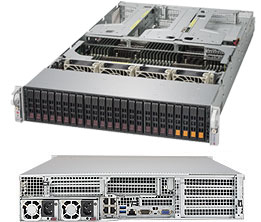
Supermicro SYS-2049U-TR4 SuperServer 2049U-TR4
| Lieske Part No. | 2517595 |
|---|---|
| Mfg Part No | SYS-2049U-TR4 |
| EAN-Code | |
| Manufacturer | Supermicro |
| Here only | 3.273,71 EUR
3.895,71 EUR incl. VAT
|
Further information for Supermicro SYS-2049U-TR4 SuperServer 2049U-TR4
| General | |
| CPU socket | Socket P (LGA 3647) |
| Processor type | 2nd Gen Intel Xeon Scalable (Cascade Lake/Skylake) |
| Memory card slots | 48 DIMMs |
| Maximum storage capacity | 12 TB |
| Memory type | 3DS ECC DDR4-2933 MHz RDIMM/LRDIMM |
| PCI-E slots | 5 x8, 6 x16 |
| LAN ports | 4 GbE via AOC-2UR66-i4G |
| Drives | 24 Hot-swap 2.5" SAS3/SATA3 |
| Hybrid ports | 4 with NVMe support via AOC |
| GPU support | up to 2 Active Cooling GPUs |
| Cooling | 4x 8cm heavy duty Fans |
| Current supply | 1600W redundant |
| Efficiency | Titanium Level (96%) |
| Form factor | 2U Rackmount |
| Optane DCPMM support | |
| IPMI LAN port | |
Applications
The SYS-2049U-TR4 is suitable for applications requiring high processor performance, large memory capacities, and a robust storage architecture. Typical use cases include high-availability systems, virtual infrastructures, database servers, backup and archiving solutions, as well as high-performance computing. Support for up to 24 hot-swap 2.5-inch storage drives in SAS3/SATA3 technology enables a flexible and scalable storage solution. The drives can be operated via an optional add-on RAID controller, allowing redundant storage configurations.
Features and Equipment in Detail
The server features 48 DIMM slots, enabling a maximum memory capacity of up to 12 TB. It supports 3DS ECC DDR4-2933 MHz RDIMM and LRDIMM modules, ensuring high memory integrity and reliability. Additionally, the platform is compatible with Intel Optane DCPMM, enabling the use of persistent memory for specific applications. The memory architecture is thus designed for demanding, data-intensive applications.
Technology Explained Simply
The platform offers a total of eleven PCI-Express 3.0 slots: five x8 and six x16, which can be used for installing network and storage expansions as well as graphics cards. Network connectivity is provided via four GbE LAN ports, implemented through an AOC-2UR66-i4G card. Additionally, a dedicated IPMI LAN port is integrated, enabling remote maintenance and monitoring of the server over the network. Power supply is provided by 1600W redundant power supplies of Titanium class (96% efficiency), ensuring high energy efficiency and reliability. Cooling is ensured by four 8 cm heavy-duty fans, providing efficient heat dissipation.
Compatibility and Accessories
The server supports up to two active cooling graphics cards, making it suitable for GPU-based applications such as machine learning or data analysis. The 24 hot-swap drives can be expanded with optional add-on cards for NVMe support, enabling a combination of SATA/SAS and NVMe drives. The drives are integrated into hybrid ports that accept both SATA and NVMe modules, with NVMe support realised via an additional AOC card.
Mounting and Installation
The server is designed in 2U rack format with dimensions of 437 mm (width), 89 mm (height), and 780 mm (depth). Mounting is performed in standard 19-inch racks, with predefined mounting points and fastening elements facilitating installation. The hot-swap drives allow for easy maintenance and replacement without system downtime. The redundant power supply and integrated IPMI function support a secure and remotely controlled operating environment.
Operational Advantages
The combination of four processors, large memory capacity, and flexible expandability makes the SYS-2049U-TR4 a powerful platform for demanding IT environments. The high energy efficiency of the Titanium power supplies reduces power consumption and operating costs. IPMI control enables remote management, simplifying server maintenance and monitoring even from a distance. The hot-swap function of the drives increases system availability, as replacement and maintenance can be performed without interrupting operations.

This is an offer of:
79279 Vörstetten
https://industry-electronics.com
Tel. 07666/88499-0
Fax. 07666/88499-111
Diesen Artikel finden Sie unter:
industry-electronics.com/artikel/2517595

Lieske Elektronik e.K.
Reutener Str. 1079279 Vörstetten
https://industry-electronics.com
Tel. 07666/88499-0
Fax. 07666/88499-111
Diesen Artikel finden Sie unter:
industry-electronics.com/artikel/2517595