
Supermicro SYS-2029U-TR4 SuperServer 2029U-TR4
Computer Hardware > Server > Barebone-Servers
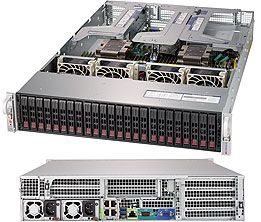
Supermicro SYS-2029U-TR4 SuperServer 2029U-TR4
| Lieske Part No. | 2517587 |
|---|---|
| Mfg Part No | SYS-2029U-TR4 |
| EAN-Code | |
| Manufacturer | Supermicro |
| Here only | 2.237,29 EUR
2.662,38 EUR incl. VAT
|
Further information for Supermicro SYS-2029U-TR4 SuperServer 2029U-TR4
| General | |
| CPU socket | LGA 3647 |
| Processor type | 2nd Gen Intel Xeon Scalable (Cascade Lake/Skylake) |
| Memory card slots | 24 DIMMs |
| Maximum memory | 6 TB |
| Memory type | DDR4-2933 MHz RDIMM/LRDIMM |
| PCI-Express slots | 1x x16, 5x x8 (FH), 1x x8 (LP), 1x x8 (intern LP) |
| Network connections | 4x 1 GbE LAN |
| Network controller | Intel i35024 |
| Drive bays | 14x 2,5" Hot-Swap SATA3 |
| Optional drive bays | 2x 2.5" Hot-Swap (rear), 20x SAS3, 4x NVMe/SAS3 |
| M.2 ports | Optional |
| Cooling | 4x 8cm PWM-Lüfter |
| Current supply | Redundant |
| Efficiency class | Titanium Level (96%) |
| Form factor | 2U Rackmount |
| Optane support | |
Applications
The server is designed for use in data centres, corporate networks, and IT infrastructures requiring high availability and performance. Support for up to 6 TB of memory via 24 DIMM slots makes it particularly suitable for applications with high memory requirements, such as in-memory databases or large virtual machines. Integrated networking functionality with four 1 GbE LAN ports via Intel i35024 enables flexible network integration.
Features and equipment in detail
The SYS-2029U-TR4 offers 24 DIMM slots, which can be populated with DDR4-2933 MHz RDIMM or LRDIMM modules. Support for Intel Optane DCPMM extends the memory architecture with persistent memory, functioning as fast, non-volatile memory. The platform features a total of six PCI-Express 3.0 slots: one x16 slot (full-size, 10.5 L), five x8 slots (full-size, 10.5 L), one x8 slot (low-profile), and one additional x8 slot (internal, low-profile), enabling flexible expansion with graphics cards, network adapters, or storage controllers.
Technology explained simply
The CPU motherboard supports Dual-Socket-P (LGA 3647), enabling installation of two processors and thus increasing computing performance compared to single-socket systems. The memory technology with DDR4-2933 MHz RDIMM/LRDIMM offers high bandwidth and reliability through Error-Correcting Code (ECC). Support for Intel Optane DCPMM enables a memory hierarchy where fast, non-volatile memory functions as system memory, reducing latency. The network connections via Intel i35024 provide a stable, redundant connection with four 1 GbE ports, suitable for operation in high-availability networks.
Compatibility and accessories
The server is equipped with Hot-Swap 2.5-inch drive bays, with 14 SATA3 connections available as standard. Optionally, up to 20 SAS3 connections and 4 NVMe/SAS3 connections can be integrated. Two additional Hot-Swap 2.5-inch bays at the rear chassis are optionally available for SSDs. M.2 NVMe and SATA3 ports are also optionally available, enabling integration of fast SSDs for boot or cache purposes. Expansion via PCI-Express slots allows integration of various add-on cards, such as network adapters, RAID controllers, or GPU modules.
Mounting and installation
The server is designed in 2U rackmount format, with a width of 437 mm, height of 89 mm, and depth of 705.3 mm. Mounting is performed in standard 19-inch racks. Cooling is provided by four 8 cm heavy-duty PWM fans, ensuring efficient and quiet cooling. Power supply is via redundant power units with Titanium-level efficiency (96 %), ensuring high energy efficiency and reliability in operation.
Advantages in operation
The combination of Dual-Socket support, high memory capacity, and expandable memory and network options makes the SYS-2029U-TR4 a powerful platform for demanding server applications. The redundant power supply and robust cooling increase operational reliability. Modular expandability allows adaptation to future requirements without replacing the entire server. Support for Intel Optane DCPMM provides additional flexibility in memory architecture.

This is an offer of:
79279 Vörstetten
https://industry-electronics.com
Tel. 07666/88499-0
Fax. 07666/88499-111
Diesen Artikel finden Sie unter:
industry-electronics.com/artikel/2517587

Lieske Elektronik e.K.
Reutener Str. 1079279 Vörstetten
https://industry-electronics.com
Tel. 07666/88499-0
Fax. 07666/88499-111
Diesen Artikel finden Sie unter:
industry-electronics.com/artikel/2517587