
Supermicro SYS-2029P-C1RT SuperServer
Computer Hardware > Server > Barebone-Servers
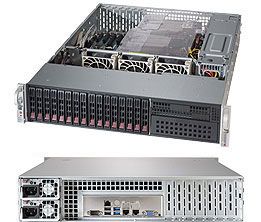
Supermicro SYS-2029P-C1RT SuperServer
| Lieske Part No. | 2517571 |
|---|---|
| Mfg Part No | SYS-2029P-C1RT |
| EAN-Code | |
| Manufacturer | Supermicro |
| Here only | 2.483,80 EUR
2.955,72 EUR incl. VAT
|
Further information for Supermicro SYS-2029P-C1RT SuperServer
| General | |
| Socket | LGA 3647 |
| Processor type | 2nd Gen Intel Xeon Scalable (Cascade Lake/Skylake) |
| Memory card slots | 16 |
| Maximum storage capacity | 4 TB |
| Memory type | 3DS ECC DDR4-2933 MHz RDIMM/LRDIMM |
| PCI-E slots | 4 x16, 1 x8 |
| AOC Support | 5 Low-Profile |
| Drive bay | 8x 2.5" SAS3, 8x 2.5" SATA3 hot-swap |
| Hard drive options | 2x 2.5" fixed NVMe/SSD/HDD, 1x M.2 |
| M.2 interface | PCI-E 3.0 x4 |
| M.2 form factors | 2260, 2280, 22110 |
| M.2 key | M-Key |
| Network connection | 2x 10GBase-T LAN |
| LAN chipset | Intel X722 |
| IPMI | 2.0 with KVM and dedicated LAN |
| SuperDOM ports | 2 |
| VGA connector | 1 |
| COM ports | 2 |
| USB 3.0 ports | 2 |
| USB 2.0 ports | 4 |
| USB Type A port | 1 |
| Fans | 3x 8cm with PWM and zone control |
| Power supply power | 1200 W |
| Power supply efficiency | Titanium Level (96%) |
| Form factor | 2U Rackmount |
Applications
The server is designed for applications requiring high processor performance, large memory capacities, and redundant components, such as virtualisation, databases, high-performance computing, or as a foundation for cloud infrastructures. The 2U form factor dimensions (width 437 mm, height 89 mm, depth 630 mm) enable efficient space utilisation in standard 19-inch racks.
Features and Equipment in Detail
The SYS-2029P-C1RT features 8 hot-swap drive bays for 2.5-inch SAS3 drives and 8 for 2.5-inch SATA3 drives, enabling flexible and service-friendly storage configuration. Optionally, a DVD-ROM drive can be integrated. For additional storage options, two fixed 2.5-inch positions for NVMe/SSD/HDD and one M.2 slot are available. The M.2 interface supports PCI-E 3.0 x4 and is designed for form factors 2260, 2280, and 22110 with M-Key connector. The integrated network connection includes two 10GBase-T LAN ports based on the Intel X722 chipset, ensuring high data transfer rates.
Technology Explained Simply
The integrated IPMI 2.0 function provides remote management capabilities with KVM (Keyboard, Video, Mouse) and a dedicated LAN port, enabling system administration even when the operating system software fails. Power supply is provided by two redundant power units with a power rating of 1200 W, featuring Titanium-level efficiency (96 %) to minimise energy consumption and operating costs. Cooling is ensured by three robust 8-cm fans with PWM control and zone regulation, enabling targeted temperature control within the housing.
Compatibility and Accessories
The server supports five low-profile add-on controllers (AOCs) via four PCI-E 3.0 x16 and one PCI-E 3.0 x8 slot, enabling expandability for network or storage controllers. Front panel interfaces include two SuperDOM ports, one VGA connector, two serial COM ports, two USB 3.0 and four USB 2.0 ports, as well as one USB Type A port. This variety of interfaces supports flexible integration into existing infrastructures.
Mounting and Installation
The server is designed for installation in standard 19-inch racks. Mounting is performed using integrated rails, ensuring secure fixation in the rack. The hot-swap drives allow for service-friendly replacement without system crash. The redundant power supply and integrated IPMI function facilitate installation and maintenance in critical environments.
Operational Advantages
With support for Intel Xeon Scalable processors and high memory capacity, the server delivers high computing performance. The redundant power supply and integrated remote management function increase availability and reduce maintenance effort. The efficient cooling and high energy efficiency of the power units contribute to low operating costs. Expandability via AOCs and the variety of interfaces enable flexible adaptation to different requirements.

This is an offer of:
79279 Vörstetten
https://industry-electronics.com
Tel. 07666/88499-0
Fax. 07666/88499-111
Diesen Artikel finden Sie unter:
industry-electronics.com/artikel/2517571

Lieske Elektronik e.K.
Reutener Str. 1079279 Vörstetten
https://industry-electronics.com
Tel. 07666/88499-0
Fax. 07666/88499-111
Diesen Artikel finden Sie unter:
industry-electronics.com/artikel/2517571