
Supermicro SYS-2029BT-HNC0R SuperServer 2029BT-HNC0R
Computer Hardware > Server > Barebone-Servers
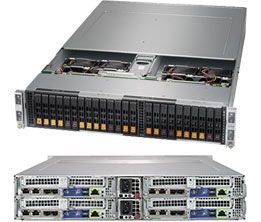
Supermicro SYS-2029BT-HNC0R SuperServer 2029BT-HNC0R
| Lieske Part No. | 2517563 |
|---|---|
| Mfg Part No | SYS-2029BT-HNC0R |
| EAN-Code | |
| Manufacturer | Supermicro |
| Here only | 6.140,34 EUR
7.307,00 EUR incl. VAT
|
Further information for Supermicro SYS-2029BT-HNC0R SuperServer 2029BT-HNC0R
| General | |
| Form factor | 2U Rackmount |
| Number of Nodes | 4 |
| CPU socket | Dual Socket P (LGA 3647) |
| Supported processors | 2nd Gen Intel Xeon Scalable (Cascade Lake/Skylake) |
| Memory card slots | 24 DIMMs |
| Maximum storage capacity | 6 TB |
| Memory type | 3DS ECC DDR4-2933 MHz RDIMM/LRDIMM |
| PCI-E slots | 2 x16 (LP) |
| SIOM card slot | 1 |
| SAS3 or NVMe drives | 6 or 4 |
| SAS3 positions | 2 |
| M.2 slots | 2 |
| M.2 support | SATA3 or NVMe |
| Carrier Card Slot | 1 |
| SAS3 controller | Broadcom 3008 |
| SAS3 mode | IT mode |
| IPMI | 2.0 |
| Video output | Aspeed AST2500 BMC |
| Cooling | 4 heavy duty 8cm PWM fans with air shroud |
| Current supply | Redundant |
| Efficiency class | Titanium Level (96%) |
| Optane DCPMM support | |
| Hot-swap 2.5-inch bays | |
| KVM | |
| Dedicated LAN | |
Applications
This server is suitable for applications requiring high computing power and simultaneous modularity, such as cloud computing, virtualization, big data processing, or high-availability infrastructures. The four independent nodes allow for flexible resource allocation and simplify maintenance, as individual systems can be replaced without taking the entire server offline. The hot-swap functionality for drives and processors supports uninterrupted operation.
Functions and Equipment in Detail
Each node supports up to 24 DIMMs with a maximum memory capacity of 6 TB, using 3DS ECC DDR4-2933 MHz RDIMM/LRDIMM modules. Support for Intel Optane DCPMM extends the memory architecture with persistent storage. Integrated network connectivity requires combination with a network card module, with a SIOM card slot available to enable flexible networking options. Storage expansion includes six SAS3 or four NVMe drives, plus two additional SAS3 positions, all in hot-swap 2.5-inch bays. Two M.2 slots support SATA3 or NVMe modules, with a carrier card slot provided for additional M.2 modules.
Technology Explained Simply
SAS3 support is provided via a Broadcom 3008 controller in IT mode, enabling direct host-to-storage connection and minimizing latency. Cooling is achieved through four robust 8 cm PWM fans with airflow guides, ensuring efficient air circulation. Power supply is provided by redundant power units of Titanium class with an efficiency rating of 96 %, ensuring high energy efficiency and reliability in operation. Integrated IPMI 2.0 functionality with KVM support and dedicated LAN enables remote maintenance and system monitoring. Video output is handled by an Aspeed AST2500 BMC, which is also responsible for system monitoring.
Compatibility and Accessories
Compatibility is limited to second-generation Intel Xeon Scalable processors (Cascade Lake/Skylake). Memory expansion is limited to DDR4-2933 MHz RDIMM/LRDIMM and Intel Optane DCPMM. SAS3 and NVMe platforms are designed for use with Broadcom 3008 controller. M.2 slots support SATA3 and NVMe modules, with a carrier card slot provided for additional M.2 modules.
Mounting and Installation
The server is designed for 2 U rack mounting, with dimensions width 447 mm, height 88 mm, and depth 730 mm. Mounting is performed in standard 19-inch racks. The hot-swap functionality for drives and processors allows maintenance without system downtime. Installation requires setting up the network card and configuring IPMI functions for remote maintenance.
Operational Advantages
The modular architecture with four independent nodes offers high scalability and availability. Hot-swap features reduce downtime during maintenance. The redundant power supply of Titanium class ensures stable power delivery. Integrated IPMI 2.0 functionality with KVM enables efficient remote maintenance. Support for Intel Optane DCPMM extends the memory architecture and improves performance in memory-intensive applications. Robust cooling with PWM fans ensures reliable temperature control.

This is an offer of:
79279 Vörstetten
https://industry-electronics.com
Tel. 07666/88499-0
Fax. 07666/88499-111
Diesen Artikel finden Sie unter:
industry-electronics.com/artikel/2517563

Lieske Elektronik e.K.
Reutener Str. 1079279 Vörstetten
https://industry-electronics.com
Tel. 07666/88499-0
Fax. 07666/88499-111
Diesen Artikel finden Sie unter:
industry-electronics.com/artikel/2517563