
Supermicro SYS-2028TP-HC1R SuperServer
Computer Hardware > Server > Barebone-Servers
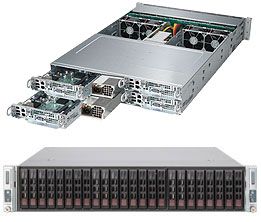
Supermicro SYS-2028TP-HC1R SuperServer
| Lieske Part No. | 2517545 |
|---|---|
| Mfg Part No | SYS-2028TP-HC1R |
| EAN-Code | 0672042168774 |
| Manufacturer | Supermicro |
| Here only | 5.095,86 EUR
6.064,07 EUR incl. VAT
|
Further information for Supermicro SYS-2028TP-HC1R SuperServer
| General | |
| Form factor | 2U Rackmount |
| Processor socket | LGA 2011 |
| Supported processors | Intel Xeon E5-2600v4/ v3 |
| QPI transfer rate | 9,6 GT/s |
| Memory | up to 2 TB ECC 3DS LRDIMM |
| Memory bus | DDR4- 2400 MHz |
| DIMM slots | 16 |
| PCI-Express slots | 1x PCI-E 3.0 x16 |
| Network interface | Intel i350-AM2 Dual port GbE LAN |
| IPMI | 2.0 with KVM and dedicated LAN |
| Hard drive bays | 6x 2.5 inch Hot-swap SAS/SATA |
| SAS controller | LSI 3108 SAS3 |
| RAID levels | 0, 1, 5, 6, 10, 50 |
| Current supply | Redundant |
| Efficiency class | Titanium Level (96%) |
Applications
This server is suitable for applications requiring high computing resource density in limited rack space, such as virtualisation, cloud computing, databases, or high-performance computing. The four independent nodes enable flexible resource allocation and maintenance without taking the entire system offline. The hot-plug functionality of the nodes and hard drives allows for a maintenance-friendly operating environment, where components can be replaced during operation.
Functions and Features in Detail
Each node provides 16 DIMM slots for up to 2 TB ECC 3DS LRDIMM memory with a maximum clock rate of DDR4- 2400 MHz. This ensures high memory capacity and bandwidth for demanding applications. A single PCI-Express 3.0 x16 slot allows installation of expansion cards, e.g. for network or storage functions. The integrated Intel i350-AM2 dual-port Gigabit Ethernet LAN interface provides redundant network connections. Additionally, IPMI 2.0 with KVM functionality and a dedicated LAN interface is integrated, enabling remote maintenance and monitoring of the server.
Technology Explained Simply
The LGA 2011 sockets support dual-processor configurations, increasing computing performance per node. The DDR4- 2400 MHz memory support ensures high data transfer rates required for modern server applications. The 6x 2.5-inch hot-swap SAS/SATA drive bays offer flexible storage expansion. The integrated LSI 3108 SAS3 controller with six ports enables configuration of various RAID levels (0, 1, 5, 6, 10, 50), ensuring data integrity and availability. The redundant power supply with Titanium-level efficiency (96 %) ensures reliable power supply and minimises energy consumption.
Compatibility and Accessories
The server is compatible with processors from the Intel Xeon E5-2600v4 and E5-2600v3 families. Memory support includes ECC 3DS LRDIMM modules up to DDR4- 2400 MHz. The network interface is based on Intel i350-AM2 technology. The integrated IPMI 2.0 function enables remote maintenance via a dedicated LAN interface. The drive bays are designed for 2.5-inch SAS/SATA drives. The RAID functions of the LSI 3108 SAS3 controller support the mentioned RAID levels.
Mounting and Installation
The server is designed as a 2U rack-mount unit and fits into standard 19-inch racks. Dimensions are 438 mm (width), 88 mm (height), and 730 mm (depth). Mounting is done via integrated rack mounting holes. The hot-plug functionality of the nodes and drives enables easy installation and maintenance without system downtime. The redundant power supply requires connection to two independent power sources for maximum availability.
Operational Advantages
The four independent nodes enable high system density and flexible resource allocation. The hot-plug functions reduce downtime during maintenance. The integrated IPMI 2.0 function with KVM and dedicated LAN interface enables efficient remote maintenance. The redundant power supply with Titanium efficiency (96 %) ensures reliability and energy efficiency. RAID level support increases data security and availability.

This is an offer of:
79279 Vörstetten
https://industry-electronics.com
Tel. 07666/88499-0
Fax. 07666/88499-111
Diesen Artikel finden Sie unter:
industry-electronics.com/artikel/2517545

Lieske Elektronik e.K.
Reutener Str. 1079279 Vörstetten
https://industry-electronics.com
Tel. 07666/88499-0
Fax. 07666/88499-111
Diesen Artikel finden Sie unter:
industry-electronics.com/artikel/2517545