
Supermicro SYS-120TP-DC9TR Twin SuperServer
Computer Hardware > Server > Barebone-Servers
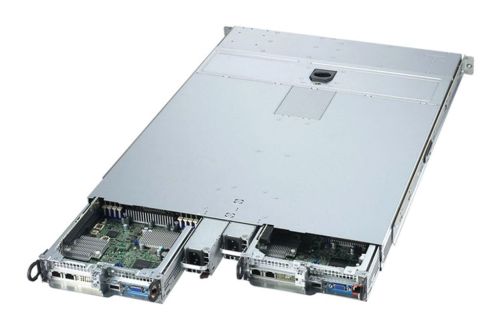
Supermicro SYS-120TP-DC9TR Twin SuperServer
| Lieske Part No. | 2517502 |
|---|---|
| Mfg Part No | SYS-120TP-DC9TR |
| EAN-Code | |
| Manufacturer | Supermicro |
| Here only | 5.262,63 EUR
6.262,53 EUR incl. VAT
|
Further information for Supermicro SYS-120TP-DC9TR Twin SuperServer
| General | |
| CPU socket | 2 (DP) |
| CPU socket type | LGA-4189 |
| DRAM slots | 16 |
| DRAM type | DDR4 |
| HE | 1U |
| Power supplies | 2 |
| Onboard LAN | 10Gbit/s |
| Server type | High Density Server |
| Processor family | 3rd Generation Intel® Xeon® Scalable |
| Chipset | Intel® C621A |
| Maximum Memory Capacity | 4 TB |
| Memory type | 3DS ECC DDR4-3200 LRDIMM/RDIMM |
| PCIe slots | 1 x16 (LP), 1 x8 |
| NVMe support | Yes, with M.2 adapter |
| LAN controller | Intel® X710 Dual port 10GBase-T |
| SAS controller | Broadcom® 3908 SAS (12Gbps) |
| RAID support | 0, 1, 5, 6, 10 |
| Drive bays | 4x 2,5 Zoll hot-swap SATA/SAS |
| Fans | 6 counter-rotating 4cm PWM |
| Power supply power | 1000 W |
| BMC | ASPEED AST2600 |
| Connections | 2 USB, VGA |
| Form factor | 1U rackmount |
| Onboard graphics | |
| Power supply redundancy | |
Applications
The server is designed for high-performance applications in data centers and data centers, particularly for virtualization, cloud computing, big data analytics, and other compute-intensive tasks. The dual-node structure in a 1U housing enables efficient use of rack space, increasing server density. Support for redundant components such as power supplies and fans ensures higher availability and operational reliability.
Features and Equipment in Detail
Each node includes an integrated Intel® X710 Dual-Port 10GBase-T LAN controller, enabling fast network connectivity via Ethernet. The network connectivity is designed for modern, highly available networks. Additionally, the server offers a PCIe 4.0 x16 (LP) and a PCIe 4.0 x8 slot, with the second slot supporting up to two NVMe SSDs in 22x80 mm format when a M.2 adapter is installed. This expands storage options and enables fast, direct access to flash storage.
Technology Explained Simply
The platform uses LGA-4189 CPU sockets designed for the 3rd generation Intel® Xeon® Scalable processors. These processors are designed for high computing performance and energy efficiency. The 16 DIMM slots per node support DDR4-3200 memory with ECC error correction, which is important for critical applications. The 3DS technology enables higher memory density. The integrated graphics function (onboard) provides basic display output via VGA and USB connections, which is useful for maintenance and diagnostics. The ASPEED AST2600 BMC (Baseboard Management Controller) enables remote maintenance and monitoring via IPMI, allowing the server to be monitored and controlled remotely.
Compatibility and Accessories
The server is equipped with a Broadcom® 3908 SAS controller supporting a data transfer rate of 12 Gbps. This controller enables the use of four 2.5-inch SATA/SAS drives per node in hot-swap modules, ensuring easy replacement and maintenance. RAID functions 0, 1, 5, 6, and 10 offer flexible configuration options for storage redundancy and performance. The two redundant power supply modules with 1000W power output and PMBus support ensure reliable power supply. The 6 counter-rotating 4cm PWM fans per system ensure optimal cooling with variable speed control.
Mounting and Installation
The server is designed as a 1U rack-mount system, with dimensions of 43 mm (height), 438 mm (width), and 718 mm (depth). Mounting is done in standard 19-inch racks. The hot-plug function of the two nodes allows replacement without system downtime, which is important for continuous operational readiness. The integrated fans and redundant power supply reduce the risk of failures due to hardware faults.
Operational Advantages
The combination of high computing performance, high memory density, and redundant components ensures high availability and efficiency. Remote maintenance functions via the BMC simplify system monitoring and maintenance, especially in distributed infrastructure. Support for NVMe SSDs and fast network connectivity enable high I/O performance, which is crucial for modern applications. The 1U form factor maximizes server density in the rack, reducing infrastructure costs.

This is an offer of:
79279 Vörstetten
https://industry-electronics.com
Tel. 07666/88499-0
Fax. 07666/88499-111
Diesen Artikel finden Sie unter:
industry-electronics.com/artikel/2517502

Lieske Elektronik e.K.
Reutener Str. 1079279 Vörstetten
https://industry-electronics.com
Tel. 07666/88499-0
Fax. 07666/88499-111
Diesen Artikel finden Sie unter:
industry-electronics.com/artikel/2517502