
Supermicro SYS-1029U-TR4 SuperServer 1029U-TR4
Computer Hardware > Server > Barebone-Servers
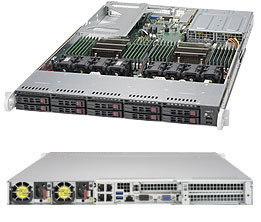
Supermicro SYS-1029U-TR4 SuperServer 1029U-TR4
| Lieske Part No. | 2517463 |
|---|---|
| Mfg Part No | SYS-1029U-TR4 |
| EAN-Code | |
| Manufacturer | Supermicro |
| Here only | 1.751,25 EUR
2.083,99 EUR incl. VAT
|
Further information for Supermicro SYS-1029U-TR4 SuperServer 1029U-TR4
| General | |
| Socket | LGA 3647 |
| Processor type | 2nd Gen. Intel Xeon Scalable (Cascade Lake/Skylake) |
| Memory card slots | 24 DIMMs |
| Maximum storage capacity | 6 TB |
| Memory type | 3DS ECC DDR4-2933 MHz RDIMM/LRDIMM |
| PCIe slots | 2 x PCIe 3.0 x16 (FH, 10.5 L), 2 x PCIe 3.0 x8 (1 LP, 1 internal LP) |
| Network connections | 4 Gigabit Ethernet |
| Drive carrier | 10 Hot-swap 2.5" |
| SATA ports | 10 SATA3 (2 hybrid ports - 2 NVMe opt.) |
| M.2 options | optional M.2 NVMe and SATA3 |
| Cooling | 8 heavy duty fans with optimal speed control |
| Current supply | 750W redundant |
| Efficiency | Platinum Level (94%+) |
| Form factor | 1U rackmount |
| Optane DCPMM support | |
Applications
The server is suitable for applications in high-performance computing, virtualisation, cloud computing, and databases. The combination of dual-socket support, high memory capacity, and multiple PCIe slots makes it particularly suitable for environments with high I/O and computing demands. The 10 hot-swap 2.5-inch drive carriers enable a flexible and service-friendly configuration with SATA3 or optional NVMe drives. Two of the SATA3 connections are configured as hybrid ports, allowing the use of NVMe drives at these positions.
Features and Equipment in Detail
The system features two PCIe 3.0 x16 slots in full-height format (10.5 L) as well as two PCIe 3.0 x8 slots, one of which is low-profile and the other internal low-profile format. This configuration provides sufficient connection options for network cards, storage expansions, or GPUs. Network connectivity is provided via four Gigabit Ethernet ports, ensuring a stable and fast connection to the network. Optionally, M.2 slots for NVMe or SATA3 drives can be added to further expand the storage architecture.
Technology Explained Simply
The 8 heavy-duty fans with optimal speed control ensure efficient cooling of the system, guaranteeing high operational reliability and component longevity. Power supply is provided by two redundant 750-watt power supplies of Platinum class, featuring an efficiency of over 94%. This reduces energy consumption and lowers operating costs. The redundant power supply increases server availability, as the system can continue to operate in the event of a power supply failure.
Compatibility and Accessories
The system is compatible with Intel Xeon Scalable processors of the second generation (Cascade Lake/Skylake) and supports DDR4-2933 MHz memory in RDIMM and LRDIMM formats. Support for Intel Optane DCPMM expands memory options for applications requiring persistent memory. The PCIe slots allow integration of various expansion cards, with the number and form factors adaptable to the specific application requirements.
Mounting and Installation
The server is designed in 1U rack-mount format, with a height of 1.7 inches (43 mm), a width of 17.2 inches (437 mm), and a depth of 27.8 inches (707 mm). These dimensions conform to common rack standards and allow easy installation in existing server racks. The hot-swap drive carriers simplify maintenance and drive replacement without disassembling the system.
Operational Advantages
The combination of dual-socket support, high memory capacity, redundant power supplies, and efficient cooling ensures high availability and performance density. The use of Platinum power supplies reduces energy consumption and lowers operating costs. The flexible configuration with various memory and expansion options allows adaptation to specific requirements of the respective application environment.

This is an offer of:
79279 Vörstetten
https://industry-electronics.com
Tel. 07666/88499-0
Fax. 07666/88499-111
Diesen Artikel finden Sie unter:
industry-electronics.com/artikel/2517463

Lieske Elektronik e.K.
Reutener Str. 1079279 Vörstetten
https://industry-electronics.com
Tel. 07666/88499-0
Fax. 07666/88499-111
Diesen Artikel finden Sie unter:
industry-electronics.com/artikel/2517463