
Supermicro SYS-1029U-E1CRT SuperServer 1029U-E1CRT
Computer Hardware > Server > Barebone-Servers
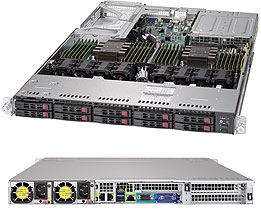
Supermicro SYS-1029U-E1CRT SuperServer 1029U-E1CRT
| Lieske Part No. | 2517458 |
|---|---|
| Mfg Part No | SYS-1029U-E1CRT |
| EAN-Code | |
| Manufacturer | Supermicro |
| Here only | 1.947,88 EUR
2.317,98 EUR incl. VAT
|
Further information for Supermicro SYS-1029U-E1CRT SuperServer 1029U-E1CRT
| General | |
| Processor socket | LGA 3647 |
| Processor type | 2nd Gen Intel Xeon Scalable (Cascade Lake/Skylake) |
| Memory card slots | 24 |
| Maximum memory | 6 TB |
| Memory type | 3DS ECC DDR4-2933 MHz RDIMM/LRDIMM |
| PCI-E slots | 2x x16 (FH, 10.5 L), 2x x8 (1 LP, 1 internal LP) |
| Network connection | 2x 10GBase-T |
| Storage bays | 10 Hot-swap 2.5" |
| SAS/SATA ports | 10 |
| M.2 ports | Optional |
| Number of fans | 8 |
| Power adaptor | 2x 750W redundant |
| Power supply efficiency | Platinum Level (94%+) |
| Form factor | 1U rackmount |
Applications
The server is intended for use in professional IT environments, particularly in data centres, where high availability, performance, and energy efficiency are required. The 1U form factor enables dense installation in standard 19-inch racks, minimising space requirements. Support for 10GBase-T network interfaces makes it suitable for high-speed networks required in modern data centres.
Features and Equipment in Detail
The system features 24 DIMM slots supporting up to 6 TB of memory in the form of 3DS ECC DDR4-2933 MHz RDIMM or LRDIMM. This memory technology ensures high reliability through error correction (ECC) and enables high bandwidth. Additionally, support for Intel Optane DCPMM (Persistent Memory) is provided, allowing expansion of the memory space with persistent memory architecture. Memory expansion is particularly beneficial for applications requiring high memory capacity and fast data access speed.
Technology Explained Simply
The platform offers two PCI-E 3.0 x16 slots (full-size, 10.5 L) and two PCI-E 3.0 x8 slots (one low-profile, one internal low-profile), which can be used for installing graphics cards, network adapters, or storage expansions. The integrated 2x 10GBase-T Ethernet ports enable a network connection at a speed of 10 Gbit/s over standard Ethernet cables, which is essential for modern network infrastructures. The 10 hot-swap 2.5-inch drive bays offer flexible and maintenance-friendly storage expansion, with the 10 SAS3/SATA3 ports provided via an expander and AOC (Adapter on Card). Optional M.2 NVMe and SATA3 ports are available, providing additional storage options for fast SSDs.
Compatibility and Accessories
The system is equipped with 8 robust fans featuring optimal speed control to ensure efficient cooling while reducing noise. Power supply is provided by two redundant 750W power supplies of Platinum class (efficiency 94% and higher), ensuring high energy efficiency and reliability in power delivery. The redundancy of the power supplies increases system availability, as in the event of a failure of one power supply, the other maintains operation.
Mounting and Installation
The server is designed as a 1U rack-mount system, with dimensions of height 1.7 inch (43 mm), width 17.2 inch (437 mm), and depth 28.5 inch (724 mm). Mounting is done in standard 19-inch racks, with the weight specification of 48 lbs (21.8 kg) supporting transport and installation planning. The hot-swap function of the drive bays enables maintenance-friendly installation and replacement of hard drives without system crash.
Advantages in Operation
The combination of dual-socket support, high memory capacity, fast network connections, and redundant power supplies makes the server a powerful solution for demanding IT environments. The energy efficiency of the Platinum power supplies reduces power consumption and lowers operating costs. The modular design allows flexible adaptation to specific requirements, with components selected and installed as needed. The hot-swap functions and optimal cooling contribute to the availability and maintainability of the system.

This is an offer of:
79279 Vörstetten
https://industry-electronics.com
Tel. 07666/88499-0
Fax. 07666/88499-111
Diesen Artikel finden Sie unter:
industry-electronics.com/artikel/2517458

Lieske Elektronik e.K.
Reutener Str. 1079279 Vörstetten
https://industry-electronics.com
Tel. 07666/88499-0
Fax. 07666/88499-111
Diesen Artikel finden Sie unter:
industry-electronics.com/artikel/2517458