
Supermicro SYS-1028U-TN10RT+ SuperServer 1028U-TN10RT+ (Complete System Only)
Computer Hardware > Server > Barebone-Servers
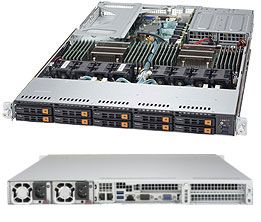
Supermicro SYS-1028U-TN10RT+ SuperServer 1028U-TN10RT+ (Complete System Only)
| Lieske Part No. | 2517433 |
|---|---|
| Mfg Part No | SYS-1028U-TN10RT |
| EAN-Code | 0672042188062 |
| Manufacturer | Supermicro |
| Here only | 2.396,90 EUR
2.852,31 EUR incl. VAT
|
Further information for Supermicro SYS-1028U-TN10RT+ SuperServer 1028U-TN10RT+ (Complete System Only)
| General | |
| Socket type | LGA 2011 |
| Supported processors | Intel Xeon E5-2600v4/ v3 Family |
| QPI transfer rate | 9,6 GT/s |
| Maximum storage capacity | 3 TB |
| Memory module type | ECC 3DS LRDIMM |
| Maximum memory bandwidth | DDR4- 2400 MHz |
| DIMM slots | 24 |
| PCI-Express slots | 3 x8 |
| PCI-Express form factor | 2x FH 10.5 L, 1x LP |
| Network connections | 2 10GBase-T |
| Drive carriers | 10 2.5 inch Hot-Swap |
| NVMe connections | 6 (via CPU 1) |
| Hybrid connectors | 4 NVMe/SAS3 (via CPU 2) |
| Number of fans | 8 piece |
| Current supply | 1000 W |
| Power Supply Efficiency | Titanium Level (96 %) |
| Form factor | 1U rackmount |
| Height | 1,7 Inch (43 mm) |
| Weight total | 48 lbs (21.8 kg) |
Applications
This server is suitable for applications in high-performance computing, virtualisation, databases, storage solutions, and network services. The combination of a dual-socket platform, high memory capacity, and multiple high-speed network connections makes it particularly suitable for environments requiring high I/O performance and parallel processing. The 1U form factor enables dense installation in standard 19-inch racks.
Features and Specifications in Detail
The SYS-1028U-TN10RT+ supports up to 3 TB of memory in the form of ECC 3DS LRDIMMs, with a maximum memory bandwidth of up to DDR4- 2400 MHz. The platform features 24 DIMM slots, allowing flexible scaling of memory capacity. The integrated memory architecture supports the requirements of modern virtualisation and cloud environments, where high memory throughput and high reliability are essential.
Technology Explained Simply
The platform supports 3 PCI-Express 3.0 x8 slots, two of which are in Full-Height 10.5-inch length format and one in Low-Profile format. These slots allow installation of network adapters, storage controllers, or graphics cards. Two 10GBase-T network ports are directly integrated on the motherboard, ensuring high network bandwidth for data transfer and server communication. The network ports are designed for use in modern, highly available network infrastructures.
Compatibility and Accessories
The server features 10 hot-swap 2.5-inch drive carriers, configurable for various storage formats. Six of the connections are designated for NVMe drives (via CPU 1), while four additional connections function as NVMe/SAS3 hybrid ports, optionally usable for SAS3 or SATA3 drives (via CPU 2). This configuration enables a flexible storage architecture that can be optimised for either high speed or high capacity. The use of NVMe drives enables extremely high I/O performance, while SAS3 and SATA3 drives are suitable for larger storage capacities.
Mounting and Installation
The server is designed as a 1U rackmount system, with a height of 1.7 inches (43 mm), width of 17.2 inches (437 mm), and depth of 27.8 inches (707 mm). Mounting is performed in standard 19-inch racks. The integrated cooling consists of eight robust fans with optimised speed control, ensuring efficient cooling while reducing noise. The fans are designed to enable even airflow within the housing and maintain component temperatures within acceptable limits.
Operational Advantages
The platform features redundant power supplies with a power rating of 1000 watts, achieving Titanium level efficiency (96% efficiency). These power supplies ensure high energy efficiency and extend component lifespan by reducing heat generation. The redundancy of the power supplies increases server availability, as in the event of a failure of one power supply, the other continues to maintain operation. The combination of high memory capacity, fast network connections, and flexible storage architecture makes the server a powerful solution for demanding IT environments.

This is an offer of:
79279 Vörstetten
https://industry-electronics.com
Tel. 07666/88499-0
Fax. 07666/88499-111
Diesen Artikel finden Sie unter:
industry-electronics.com/artikel/2517433

Lieske Elektronik e.K.
Reutener Str. 1079279 Vörstetten
https://industry-electronics.com
Tel. 07666/88499-0
Fax. 07666/88499-111
Diesen Artikel finden Sie unter:
industry-electronics.com/artikel/2517433